Thursday, May 20, 2010

Matthew Buckley Explains the True Purpose of Marriage


Living Tradition
ORGAN OF THE ROMAN THEOLOGICAL FORUM

Editor: Msgr. John F. McCarthy, J.C.D., S.T.D. Distributed several times a year to interested members.
Associate Editor: Rev. Brian W. Harrison, O.S., M.A., S.T.D. Not to be republished without permission.
Please address all correspondence to: www.rtforum.org e-mail: jfm@rtforum.org

Living Tradition, Oblates of Wisdom, P.O. Box 13230, St. Louis, MO 63157, USA

No. 144 Roman Theological Forum | Article Index | Study Program January 2010

THE REASON AND PURPOSE OF MATRIMONY

by Matthew Buckley

Read this excellent article at: http://www.rtforum.org/lt/lt144.html

Thursday, March 4, 2010

Justice of God Manifested Through Faith in Jesus Christ


Text of pope’s message for Lent 2010

(Related story: Conversion breaks bonds of selfishness, pope says in Lenten message)
VATICAN CITY — Pope Benedict XVI’s message for Lent 2010 was released by the Vatican today at a press conference. Here is the full text:
Dear Brothers and Sisters!
Each year, on the occasion of Lent, the Church invites us to a sincere review of our life in light of the teachings of the Gospel. This year, I would like to offer you some reflections on the great theme of justice, beginning from the Pauline affirmation: “The justice of God has been manifested through faith in Jesus Christ” (cf. Rm 3, 21-22).
Justice: “dare cuique suum”

A young survivor of the Haitian earthquake. (CNS/Bob Roller)
First of all, I want to consider the meaning of the term “justice,” which in common usage implies “to render to every man his due,” according to the famous expression of Ulpian, a Roman jurist of the third century. In reality, however, this classical definition does not specify what “due” is to be rendered to each person. What man needs most cannot be guaranteed to him by law. In order to live life to the full, something more intimate is necessary that can be granted only as a gift: we could say that man lives by that love which only God can communicate since He created the human person in His image and likeness. Material goods are certainly useful and required – indeed Jesus Himself was concerned to heal the sick, feed the crowds that followed Him and surely condemns the indifference that even today forces hundreds of millions into death through lack of food, water and medicine – yet “distributive” justice does not render to the human being the totality of his “due.” Just as man needs bread, so does man have even more need of God. Saint Augustine notes: if “justice is that virtue which gives every one his due … where, then, is the justice of man, when he deserts the true God?” (De civitate Dei, XIX, 21).
What is the Cause of Injustice?
The Evangelist Mark reports the following words of Jesus, which are inserted within the debate at that time regarding what is pure and impure: “There is nothing outside a man which by going into him can defile him; but the things which come out of a man are what defile him … What comes out of a man is what defiles a man. For from within, out of the heart of man, come evil thoughts” (Mk 7, 14-15, 20-21). Beyond the immediate question concerning food, we can detect in the reaction of the Pharisees a permanent temptation within man: to situate the origin of evil in an exterior cause. Many modern ideologies deep down have this presupposition: since injustice comes “from outside,” in order for justice to reign, it is sufficient to remove the exterior causes that prevent it being achieved. This way of thinking – Jesus warns – is ingenuous and shortsighted. Injustice, the fruit of evil, does not have exclusively external roots; its origin lies in the human heart, where the seeds are found of a mysterious cooperation with evil. With bitterness the Psalmist recognises this: “Behold, I was brought forth in iniquity, and in sin did my mother conceive me” (Ps 51,7). Indeed, man is weakened by an intense influence, which wounds his capacity to enter into communion with the other. By nature, he is open to sharing freely, but he finds in his being a strange force of gravity that makes him turn in and affirm himself above and against others: this is egoism, the result of original sin. Adam and Eve, seduced by Satan’s lie, snatching the mysterious fruit against the divine command, replaced the logic of trusting in Love with that of suspicion and competition; the logic of receiving and trustfully expecting from the Other with anxiously seizing and doing on one’s own (cf. Gn 3, 1-6), experiencing, as a consequence, a sense of disquiet and uncertainty. How can man free himself from this selfish influence and open himself to love?
Justice and Sedaqah
At the heart of the wisdom of Israel, we find a profound link between faith in God who “lifts the needy from the ash heap” (Ps 113,7) and justice towards one’s neighbor. The Hebrew word itself that indicates the virtue of justice, sedaqah, expresses this well. Sedaqah, in fact, signifies on the one hand full acceptance of the will of the God of Israel; on the other hand, equity in relation to one’s neighbour (cf. Ex 20, 12-17), especially the poor, the stranger, the orphan and the widow (cf. Dt 10, 18-19). But the two meanings are linked because giving to the poor for the Israelite is none other than restoring what is owed to God, who had pity on the misery of His people. It was not by chance that the gift to Moses of the tablets of the Law on Mount Sinai took place after the crossing of the Red Sea. Listening to the Law presupposes faith in God who first “heard the cry” of His people and “came down to deliver them out of hand of the Egyptians” (cf. Ex 3,8). God is attentive to the cry of the poor and in return asks to be listened to: He asks for justice towards the poor (cf. Sir 4,4-5, 8-9), the stranger (cf. Ex 22,20), the slave (cf. Dt 15, 12-18). In order to enter into justice, it is thus necessary to leave that illusion of self-sufficiency, the profound state of closure, which is the very origin of injustice. In other words, what is needed is an even deeper “exodus” than that accomplished by God with Moses, a liberation of the heart, which the Law on its own is powerless to realize. Does man have any hope of justice then?
Christ, the Justice of God
The Christian Good News responds positively to man’s thirst for justice, as Saint Paul affirms in the Letter to the Romans: “But now the justice of God has been manifested apart from law … the justice of God through faith in Jesus Christ for all who believe. For there is no distinction; since all have sinned and fall short of the glory of God, they are justified by His grace as a gift, through the redemption which is in Christ Jesus, whom God put forward as an expiation by his blood, to be received by faith” (3, 21-25). What then is the justice of Christ? Above all, it is the justice that comes from grace, where it is not man who makes amends, heals himself and others. The fact that “expiation” flows from the “blood” of Christ signifies that it is not man’s sacrifices that free him from the weight of his faults, but the loving act of God who opens Himself in the extreme, even to the point of bearing in Himself the “curse” due to man so as to give in return the “blessing” due to God (cf. Gal 3, 13-14). But this raises an immediate objection: what kind of justice is this where the just man dies for the guilty and the guilty receives in return the blessing due to the just one? Would this not mean that each one receives the contrary of his “due”? In reality, here we discover divine justice, which is so profoundly different from its human counterpart. God has paid for us the price of the exchange in His Son, a price that is truly exorbitant. Before the justice of the Cross, man may rebel for this reveals how man is not a self-sufficient being, but in need of Another in order to realize himself fully. Conversion to Christ, believing in the Gospel, ultimately means this: to exit the illusion of self-sufficiency in order to discover and accept one’s own need – the need of others and God, the need of His forgiveness and His friendship. So we understand how faith is altogether different from a natural, good-feeling, obvious fact: humility is required to accept that I need Another to free me from “what is mine,” to give me gratuitously “what is His.” This happens especially in the sacraments of Reconciliation and the Eucharist. Thanks to Christ’s action, we may enter into the “greatest” justice, which is that of love (cf. Rm 13, 8-10), the justice that recognises itself in every case more a debtor than a creditor, because it has received more than could ever have been expected. Strengthened by this very experience, the Christian is moved to contribute to creating just societies, where all receive what is necessary to live according to the dignity proper to the human person and where justice is enlivened by love.
Dear brothers and sisters, Lent culminates in the Paschal Triduum, in which this year, too, we shall celebrate divine justice – the fullness of charity, gift, salvation. May this penitential season be for every Christian a time of authentic conversion and intense knowledge of the mystery of Christ, who came to fulfill every justice. With these sentiments, I cordially impart to all of you my Apostolic Blessing.
From the Vatican, 30 October 2009
BENEDICTUS PP. XVI

Thursday, February 4, 2010

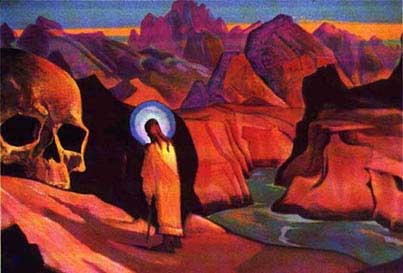
Jesus as the "Issa" of Tibetan religion


-->
Taken from our "Lost Cultural Foundations of Eastern Civilization"
CHAPTER ONE: ISSA

Kersten kicks off with the story of Nicolai Notovitch, a 'Russian historian and itinerant scholar', who in 1887 is alleged to have had a most interesting encounter with a lama in Ladakh, Tibet (though he will add on p. 15 that German expert on India, Max Müller, would later dispute this, saying that Notovitch's presence in Ladakh was 'not documented'). Kersten tells of the alleged conversation that took place between the Russian and a lama at a Buddhist monastery, in which the lama recognizes for his leader, the Dalai Lama, a status similar to that which Catholics accord to the Pope (pp.7f.):
Notovitch eventually arrived at a Buddhist monastery where, as a European, he was afforded a reception that was much more cordial than any Asiatic Muslim might have expected. He asked a lama why he should be favoured in this way, and the following conversation took place:
'The Muslims have little in common with our religion. Indeed, not long ago they waged an all-too-successful campaign to forcibly convert a number of our Buddhists to Islam. It has caused us immense difficulty to reconvert these ex-Buddhist Muslims back to the way of the true God. Now the Europeans are altogether different. Not only do they profess the essential principles of monotheism, they have almost as much title to be considered worshippers of the Buddha as the lamas of Tibet themselves. The only difference between the Christians and ourselves is that, after having adopted the great doctrines of Buddha, the Christians have parted from him completely by creating for themselves a different Dalai Lama. Our Dalai Lama alone retained the divine gift of seeing the majesty of Buddha, and the power to act as an intermediary between earth and Heaven'.
'Who is this Christian Dalai Lama you are talking about?' asked Notovitch. 'We have a Son of God, to whom we direct our fervent prayers, and whom in time of need we beseech to intercede for us with our one and indivisible God …'
'It is not of him I speak, Sahib! We too respect the one you recognize as Son of the one God – not that we see in him an only Son, rather a Being perfect among all the elect. The spirit of Buddha was indeed incarnate in the sacred person of Issa, who, without aid from fire or sword, has spread knowledge of our great and true religion throughout the world. I speak instead of your earthly Dalai Lama, him to whom you have given the title "Father of the Church". This is a great sin; may the flocks be forgiven who have gone astray because of it'.
And so saying, the lama hastened to turn his prayer wheel. Understanding the lama to be alluding to the Pope, Notovitch probed further.
....
'You tell me that a son of Buddha, Issa, spread your religion over the Earth. Who is he, then?'
At this question the lama opened his eyes wide and looked at his visitor in astonishment. After uttering a few words the interpreter did not catch, he explained:
'Issa is a great prophet, one of the first after the twenty-two Buddhas. He is greater than any one of the Dalai Lamas, for he constitutes part of the spiritual essence of our Lord. It is he who has enlightened you, who has brought back within the fold of religion the souls of the erring, and who allows every human being to distinguish between good and evil. His name and his deeds are recorded in our sacred writings'.
By this time Notovitch was feeling quite stunned at the lama's words, for the prophet Issa, his teaching, his martyrdom, and the reference to a Christian Dalai Lama were increasingly reminiscent of Jesus Christ.
Notovitch, according to Kersten (p. 10), would later view the sacred writings on Issa at the Hemis monastery in Leh, the capital of Ladakh, and would take notes as they were read to him via an interpreter. These notes would later be published, firstly in French. Kersten continues:
Its contents may be succinctly outlined (using the French translation as a basis):
A short introductory section precedes a brief description of the early history of the people of Israel and the life of Moses. An account then follows of how the eternal Spirit resolves to take on human form 'so that he might demonstrate by his own example how moral purity may be attained, and by freeing the soul from its rude mortality [sic], achieve the degree of perfection required to enter into the kingdom of Heaven, which is unchanging and ruled by eternal happiness'. And so a divine infant is born in faraway Israel, and is given the name Issa. Sometime during the fourteenth year of his life, the lad arrived in the region of the Sind (the Indus) in the company of merchants, 'and he settled among the Aryans, in the land beloved of God, with the intention of perfecting himself and of learning from the laws of the great Buddha'. The young Issa travels through the land of the five rivers (the Punjab), stays briefly with the 'erring Jains', and then proceeds to Jagannath, 'where the white priests of Brahma honoured him with a joyous reception'. At Jagannath Issa/Jesus learns to read and understand the Veda. But by then instructing the Sudras of the lower castes, he incurs the displeasure of the Brahmans, who feel their position and power threatened. After spending six years in Jagannath, Rajagriha, Benbares and other holy cities, he is compelled to flee the Brahmans who are outraged at his continuing to teach that it is not the will of God that the worth of human beings should be judged by their caste. [40]

This is really the Buddha all over again. And I had noted at the end of the previous article a parallel between Jesus' attitude towards the Jewish priests and Buddha's towards the Brahmans. Kersten himself will note the same with regard to Jesus and Issa (pp. 10f.):
There is an extraordinary correlation between the accounts in the texts found by Notovitch and those of the Gospels, a correlation that can shed more light on Jesus' own personality – especially in what he said. Notovitch's Issa opposes the abuses of the caste system, which rob the lower castes of their basic human rights, saying, 'God our father makes no difference between any of his children, all of whom he loves equally'. And later on in his travels he takes issue with a rigid and inhumane adherence to the letter of the law, declaring that 'The law was made for Man, to show him the way.' He consoles the weak: 'The eternal Judge, the eternal Spirit, who forms the sole and indivisible Word-soul … will proceed sternly against those who arrogate His rights to themselves.' When the priests challenge Issa to produce miracles, to prove the omnipotence of his God, he retorts, 'The miracles of our God have been performed ever since the first day when the universe was created; they take place every day and at every moment. Those who cannot perceive them are robbed of one of the most beautiful gifts of life'.
Issa, after having spent six years in Nepal, finally moves on towards the West, to Persia, where he 'also stands up to the priests of Persia, who expel him one night in the hope that he will quickly fall prey to wild animals'. And then on to Palestine. When the wise men there inquire of him 'Who are you, and from what country do you come? We have never heard of you and do not even know your name', Issa answers in terms that actually, in part, recall Moses more than they do Jesus (pp.11f.):
'I am an Israelite', Issa replies, 'and on the day of my birth I saw the walls of Jerusalem and heard the sobs of my brothers in their slavery and the wails of my sisters condemned to live among the heathen. And my soul grieved sorely when I heard that my brothers had forgotten the true God. As a child, I left my parents' home to live among other peoples. But after hearing of the great sorrows that my brothers were suffering, I returned to the land where my parents lived, in order to bring my brothers back to the faith of our ancestors, a faith which enjoins us to be patient on earth so that we might achieve the consummate and highest happiness in the Beyond.'

We saw in the previous article how legends and mythology often intertwine the lives of Christ and Moses, and this is perhaps yet another example. We saw it in the case of Mohammed, for example, and it may be that the Indian story of Issa was filtered into India through Islam. Issa's being brought up in slavery and growing up amongst foreigners, and then returning to liberate his people, is the classical story of Moses and the Oppression by pharaoh, and his adoption into the Egyptian royal family; and, later, his sojourning in the foreign country of Midian (for which the Buddhists apparently substituted India and Nepal); and then his returning to liberate his brethren (all recorded in the Book of Exodus). The name Issa though, and Jerusalem, would be more appropriate for Jesus, who achieved a spiritual – rather than Moses' physical – release of his people from their bondage (to sin).
....

Wednesday, February 3, 2010

Buddhist Borrowing of the Magi and Nativity Star


Extract from our "Lost Cultural Foundations of Eastern Civilization"


Childhood of Jesus


Before going on to record Kersten's amazing comparisons between Jesus and the Buddha, I should like to pause for a moment to touch upon a fascinating matter that the author has raised regarding the Nativity of Jesus and the Magi's star, on the one hand, and the Tibetan practice of locating child reincarnations of deceased Buddhist Dalai Lamas on the other.

In his 'Who Were the Three Wise Men?' (Chapter 4), Kersten firstly concludes on p. 63 that: "At this distance in time it is well-nigh impossible to prove that the Magi came from either Persia or from India". Then he introduces his fascinating new twist:

Yet it is absolutely amazing how much the story of the three wise men corresponds with accounts of the methods by which reincarnations of great Buddhist dignitaries are located in Tibet after their demise, even to this day. The way in which such a search is carried out, following ancient and traditional ritual, is described in the present Dalai Lama's own accounts of his 'discovery' as a little boy, and in the book by the Austrian Heinrich Harrer, who spent seven years at the court of the god-king in Lhasa.

And on p. 64, Kersten goes on to write regarding the 1937 search for the child of destiny:

… Most important to these preparations were the pronouncements of the astrologers, without whose calculations no significant moves could be made at all. At last, in 1937, various expeditions were dispatched from Lhasa to seek out the holy child according to the heavenly omens, in the direction indicated. Each group included wise and worthy lamas of highly distinguished status in the theocracy. In addition to their servants, each group took costly gifts with them ….

Is this yet another far eastern tradition that has arisen from a biblical prototype, namely the Gospel account of the Magi's visit to the Christ-child in Bethlehem (Matthew 2:1-11)?


....

Saturday, January 2, 2010

Texan Lawyer’s Attempt to Identify the Star of Bethlehem


Christmas is a celebration of the Nativity of Our Lord Jesus Christ.

It can also be a time for receiving presents that we might not really want, those really bad presents, such as a plastic candle holder, or a box of apples for someone who has bad dentures. Not everyone is as intuitive as were the Magi (gold, frankincense and myrrh).
In our mail was the new DVD, “The Star of Bethlehem”, promising to: “Unlock The Mystery of the World’s Most Famous Star”. Was this going to be another of those dud Christmas presents? Was this going to be yet another failed attempt to arrive at a convincing identification of history’s most enigmatic Star?
No, as it turned out this was one present that really does live up to expectations, and we thank the sender for it. And we also hope that our readers received the sorts of Christmas presents that they really wanted. Whilst the DVD is advertised as being: “From Producer Stephen McEveety The Passion of the Christ”, the actual brains behind the whole project is a Texan lawyer, Frederick (‘Rick’) A. Larson, whose perceptive research into the Star of Bethlehem provides the substance for this DVD. Larson has the lawyer’s detective-like knack of being able to pick up clues in, say, Matthew 2:1-12, the account of the Magi and the Star, that other readers might pass over without due pause. He brings to the narrative, awe, passion, emotion, a love and knowledge of the Scriptures (including Genesis; the Psalms; Isaiah; the Book of Job; Malachi; and Revelation), as well as the benefit of sophisticated computer software, such as the astronomical program, “Starry Night”. This last enables for him to illustrate for the benefit of his audience exactly what he is attempting to explain to it. It also results in a sumptuous visual feast.
The demand for Larson’s talks have skyrocketted, even including overseas engagements. And the DVD has already been very widely circulated. This is one case where a truly worthwhile project is getting the sort of publicity that it deserves.
 
The back of the DVD reads:

Scholars debate whether the Star of Bethlehem is a legend created by the early church or a miracle that marked the advent of Christ. Is it possible that the star was a real astronomical event?
From Producer Stephen McEveety The Passion of the Christ comes an amazing documentary on the Star of Bethlehem. This presentation has been viewed by tens of thousands in the U.S. and in Europe and this new DVD reveals the evidence for God’s existence as seen in the stars above.
Presenter Rick Larson talks you through biblical and historical clues revealing the eternal significance of this celestial event as well as the vastness of God’s creativity. Discover the secret of the Star … a secret of magnificent beauty.

BONUS FILM
The View From Beyond.

We thoroughly recommend to all this DVD, for it really serves - as the above advertisement claims - to illustrate God’s handiwork and his pre-ordained pattern, or cosmic design, in the heavens. Pope Benedict XVI spoke along somewhat similar lines of God’s creative wisdom last year, using Thomistic concepts and also directly quoting St. Thomas Aquinas:

ADDRESS OF HIS HOLINESS BENEDICT XVI
TO MEMBERS OF THE
PONTIFICAL ACADEMY OF SCIENCES
ON THE OCCASION OF THEIR PLENARY ASSEMBLY

… A decisive advance in understanding the origin of the cosmos was the consideration of being qua being and the concern of metaphysics with the most basic question of the first or transcendent origin of participated being. In order to develop and evolve, the world must first be, and thus have come from nothing into being. It must be created, in other words, by the first Being who is such by essence.
To state that the foundation of the cosmos and its developments is the provident wisdom of the Creator is not to say that creation has only to do with the beginning of the history of the world and of life. It implies, rather, that the Creator founds these developments and supports them, underpins them and sustains them continuously. Thomas Aquinas taught that the notion of creation must transcend the horizontal origin of the unfolding of events, which is history, and consequently all our purely naturalistic ways of thinking and speaking about the evolution of the world. Thomas observed that creation is neither a movement nor a mutation.

It is instead the foundational and continuing relationship that links the creature to the Creator, for he is the cause of every being and all becoming (cf. Summa Theologiae, I, q.45, a. 3).

Clementine Hall
Friday, 31 October 2008

© Copyright 2008 - Libreria Editrice Vaticana

The strength of Rick Larson’s research into the Star of Bethlehem is, as already noted, his ability to pick up crucial points of evidence in the biblical texts that others might have overlooked. He has picked up what he has called “The Nine Points of Christ’s Star” that he believes to be the key pieces in the puzzle of the sacred text, and he will not be satisfied with a final scenario that does not accommodate all nine of these. Such is Larson’s thoroughness that even eight points for him will not suffice.
Could the star have been a meteorite; a comet; a supernova; a planet; or a new star?
One point that most pick up is that the star seen by the Magi rose in the East (“Greek "en anatole”, meaning they saw his star rising in the east”. Larson). This can apply to various of these aforementioned types of heavenly bodies. Another is that it was seen for an extended period of time. Larson rules out a comet on various grounds; one being that, in antiquity, comets were generally associated with doom.
A crucial point that Larson has picked up is that Herod - and seemingly Jerusalem in general - seemed blissfully unaware of the presence of this harbinger star. It was only the arrival of the Magi in Jerusalem that had awakened Herod to the extraordinary situation that had now arisen in his kingdom. That would again rule out a comet, which the ancients (so much better attuned to the sky than we are today) would not have missed. A comet would have been “the talk of the town”, Larson rightly says.
The Magi of course, who Larson thinks may have arisen from the school of Daniel in the East, would have had the benefit of Daniel’s Messianic prophecy to guide them as to the approximate time to expect the Messiah. They were able to combine this with their expert reading of the ‘book’ of the heavens. Daniel’s prophecy no longer works for us chronologically, with its beginning in the first year of King Cyrus, now dated to 539 BC. As Martin Anstey (The Romance of Bible Chronology) and Philip Mauro (The Wonders of Bible Chronology) have shown, this date is 82 years too early for Daniel’s prophecy to work, meaning that historians have created too many Persian kings. Daniel’s count of years should begin at 457 BC instead. This point is crucial
Whatever the Star was, it did no arrest the attention of the inhabitants of Jerusalem. Another vital point is that the star stopped. This was the point that had given Larson the greatest difficulty. But then it occurred to him that the planets, due to the optical phenomenon known as “retrograde motion”, actually appear to stop. Mars does a loop; Venus does a backflip; Jupiter inscribes a shallow circle.
Larson has opted for the bright planet Jupiter as the “Star” seen by the Magi.
One of Larson’s nine points, his first in fact, has to do with chronology. And this may be his weak link, and may actually vitiate his whole argument. Larson has determined, based on an ancient version of the (not entirely reliable) Jewish historian Flavius Josephus, that the Birth of the Messiah had occurred in relation to the reign of Herod in 3-2 BC. Here is a simplification of Larson’s fascinating account of it all, from the Annunciation (in September of 3 BC) to the Birth (in June of 2 BC), reading from his computer program for that period, beginning with a most unusual triple conjunction of Jupiter and Regulus, the “King” star:

Jupiter crowns Regulus [King] in Leo [Tribe of Judah].
Up rises Virgo [the Virgin] clothed with the Sun, the Moon under her feet. It is Rosh-hashanah, the Jewish New Year.
Nine months later the biggest planet [Jupiter] goes together with the brightest planet [Venus, the Mother planet] to make the brightest star anyone alive has ever seen. Right over Jerusalem it sets.
The Magi arrive, about November, and go to Herod – ‘where is the baby king?’ Herod, after consultation with his scribes, says ‘Bethlehem’. The Magi leave on the 5-mile trek, look up and there is the star Jupiter right over the little town of Bethlehem.
The one who is doing the maths for the Magi informs them that Jupiter is in full retrograde – it has stopped. It is now the 25th of December.

It is interesting to compare this part of Larson’s scenario with mystic Anne Catherine Emmerich’s picturesque version of what the Magi saw (The Life of Jesus Christ):

There was a certain constellation at which [the Magi] always gazed, and whose variations they noted. In it they saw visions and pictures. Upon this night [of the Nativity] also, they had several visions of various kinds. It was not in one star alone that they saw those visions, but in several that formed a figure, and there seemed to be a movement in them. They saw the vision of the moon over which arose a beautiful rainbow-colored arch on which was seated a Virgin. The left limb was drawn up in a sitting posture, the right hung a little lower and rested on the moon. To the left of the Virgin and rising above the arch, was a grapevine, and on her right a sheaf of wheat. In front of the Virgin was a chalice like that used at the Last Supper. It appeared to issue, but with greater clearness and brightness, from the brilliancy that emanated from her. Out of the chalice arose a Child, and over the Child stood a bright disk like an empty ostensorium. It was surrounded by radiating beams. It reminded me of the Blessed Sacrament ….
Over the head of the Virgin sitting on the arch shone a star, which suddenly shot from its place and skimmed along the heavens before the Kings. It was for them a voice announcing as never before that the Child, so long awaited by them and by their ancestors, was at last born in Judea, and that they were to follow that star.
[End of quote]

Blessed Anne Catherine Emmerich also seems to confirm Larson’s view that Herod and Jerusalem were quite unaware of any significant signs at the time, and that this fact had caused the Magi to wonder if they had actually made the right calculations. And the Star was not always shining brightly on the Magi’s journey, as would indeed be the case with a heavenly object such as a planet.
She has the Magi taking “about sixty days” to arrive at Bethlehem.

G. Mackinlay, in The Magi: How They Recognised Christ’s Star (1907), had also determined that it was a planet, namely Venus in his case, that was the Star of the Magi. He did not, back then, have the advantage of modern computer software, as has Larson, but was reliant on astronomical charts to put a date to the circumstances of Venus that he had determined had pertained to the chronology of Jesus Christ. Mackinlay showed from the Scriptures just how significant Venus was as “the morning star” and “the evening star”, and he quotes texts from the prophet Micah; including that fateful text without which Herod, the Godfather of today’s abortionists, would never have condemned to death the children of Bethlehem. Mackinlay also shows through Micah that John the Baptist was symbolised as the morning star, heralding as it does the dawn (Christ). He was able to determine an internal chronology of Jesus Christ, and the Baptist, based on the periods of shining of the morning star, all this in connection with historical data, seasons and Jewish feasts. This is all too intricate to do justice to here. The interested reader is advised to read Mackinlay’s book at our site: http://amaic-alphaomega.blogspot.com/
Mackinlay’s is one of those theories so consistent right the way through that one suspects it must be correct. That might put severe pressure on Larson’s choice of the Magi’s Star as Jupiter. Mackinlay’s theory has the same sort of consistency as has Florence Wood’s explanation in her “Homer’s Secret ‘Iliad’” that the battles between Greeks and Trojans mirror the movements of stars and constellations as they appear to fight for ascendancy in the sky. See our http://brightmorningstar.blog.com/
Likely, too, John P. Pratt’s “The Lost Constellation Testifies of Christ”, as featured in an earlier MATRIX, will be an essential element in all of this.
The inherent weakness we think in both Larson’s and Mackinlay’s systems is their presumption that the conventional dates for Herod and Jesus Christ are basically accurate - just as 539 BC is now wrongly presumed to be a certain date for King Cyrus - and that it is therefore simply a matter of finding an astronomical scenario within that conventional period and then being able to refine the dates using sophisticated modern scientific data. This was a problem that we had when typing up Mackinlay’s book. Though the whole substance of the book was readily accepted, notes still had to be added to explain that the actual dates given there, now with such certainty on the part of Mackinlay (e.g. 26 AD for the beginning of Christ’s public ministry), had not necessarily yet been established.
Happily, neither Larson’s nor Mackinlay’s scenario has that odd situation of the shepherds watching their sheep out in the open, in winter, that critics seem to latch on to every Christmas in order to ridicule St. Matthew’s account.

We definitely think that the type of heavenly body that had guided the Magi must have been a planet. And we should favour Mackinlay’s Venus, which does however also figure in Larson’s scenario in conjunction with Jupiter, his showcase “Star”.

The solar system is like a vast clock of immense power, precision and beauty. Upon viewing the Star of Bethlehem DVD, one will better appreciate that statement in Genesis 1:14 that these objects were created to “be for signs and for seasons and for days and for years”. For if the Star wasn't magic or a special miracle from outside of the natural order, then it was something even more startling. It was a Clockwork Star. And that is overwhelming. The movement of the heavenly bodies is regular, like a great clock. The Clockwork Star finally means that from the very instant at which God flung the universe into existence, he also knew the moment he would enter human history in the person of Jesus of Nazareth. He marked it in the stars. …”. (Larson).

The Bible has provided us with an exact chronology from Adam to Jesus Christ (the “second Adam”). Though it is difficult now for human beings to arrive at the exact calculations, we can nevertheless get close. For our AD calculations, however, we do not have this advantage. But the answer must nevertheless lie with Jesus Christ, who is the key to time. He is the Lord of all History, the First and the Last; the Beginning and the End; the Alpha and the Omega. Jesus Christ is the reason for history, the creator of history, and the guide and culmination of all history (cf. Revelation 1:8; 21:6; 2:13). For a perfect chronology, one will need to be able to read this celestial clock, or cosmic book, along the lines of a Rick Larson, with the benefit of advanced computer technology perhaps - but also independently of the stumbling block that is the conventional chronology - to find at what precise point in time the Birth of the Messiah actually occurred. Who will be wise enough to do this?
As the Pope has taught:

The human mind therefore can engage not only in a “cosmography” … but also in a “cosmology” discerning the visible inner logic of the cosmos. We may not at first be able to see the harmony both of the whole and of the relations of the individual parts, or their relationship to the whole. Yet, there always remains a broad range of intelligible events, and the process is rational in that it reveals an order of evident correspondences ….
[End of quote]
For more on Christian films of this nature, go to:
http://www.christianworldview.org.au/resources.htm

Thursday, December 17, 2009

Star of Bethlehem


Frederick Larson has given a stunning interpretation of the Star.

See: http://www.bethlehemstar.com/


And from: http://www.bethlehemstar.net/press/

Coming Soon!

January 5, 2008
Christmas star debate gets its due on Epiphany
By Kim Lawton, Religion & Ethics NewsWeekly via Religion News Service
Christmas, despite what the calendar says, isn't over. And the star — "star of wonder, star of night, star with royal beauty bright" — that shone over Bethlehem won't go dim until it gets its proper due on Epiphany on Sunday (Jan. 6).
Read More

January 4, 2008
Christmas star gets its due on EpiphanyBy Kim LawtonReligion & Ethics NewsWeeklydistributed by Religion News Service
For centuries, the star has intrigued astronomers, historians, artists and theologians alike: was it a one-time miracle, a literary myth, or was it an actual astronomical occurrence?
Read More


December 24, 2007
Star of Bethlehem: Fact or Fiction?By Gailon Totheroh CBN News Science and Medical Reporter
Ever since the 1600s, people have used astronomy, history, and the Bible to try to identify the Star of Bethlehem.
So was the star something real, seen in the heavens as a sign of the coming Messiah? Or was it, as some say, merely made up by the early Church?
Read More


Religion and Ethics, December 21, 2007 episode no.1116
When the Magi arrived from the east, perhaps traveling from Persia or perhaps Babylon, they asked a question, and it's loaded. They say, "Where is the one who has been born King of the Jews?" Now something they'd seen in the sky suggested to them a connection with birth, kings, and the Jewish nation, and they saw the star when they arrived in Jerusalem. So it endures over time. So that's another clue, because most celestial objects endure over time, but not all do.
Read More


CBS 19 TV, December 20, 2007
Making the Miracle
Is the Star of Bethlehem real or myth?
The Star of Bethlehem is one of the most revered symbols of the christian faith.
But some have wondered... is it mere legend... or truly a miracle?
Read More Video


-->
ABC 13 TV, December 20, 2007
Did the star of Bethlehem exist?
A bright star appeared in the night, lighting the way to where Jesus was born.
It's the story of the star of Bethlehem. It's been passed down for generations, but did the star really exist?
Read More


December 14, 2007
Bethlehem Star: Both Natural & Miraculous?
The star of Bethlehem: Natural occurrence or miraculous event? Rick Larson believes it's not an either/or answer.An attorney and legal professor, Larson has spent the last eight years devoted to showing how he believes astronomical events in the years 3 and 2 B.C. fulfill the Bible's description of the star the Magi followed to find the young Jesus. Having given numerous PowerPoint presentations on the subject at churches, Larson has helped put together a 63-minute DVD just in time for Christmas called "The Star of Bethlehem," detailing -- with the help of a computer program -- what he believes the wise men actually saw.
Read More


December 14, 2007
Bethlehem star: both natural & miraculous?By Michael Foust
"I have heard objections from clergy who say they don't like what I'm doing because it removes the miraculous," Larson told Baptist Press. "... The reason that is wrong is because if the star was part of the natural order, and our solar system and the universe is like a great clock -- mathematically precise and predictable -- then that means that the star was a clockwork star, and that of course means that God built the star into the structure of the solar system in the universe from the beginning of time.
Read More

December 10, 2007
Texas Professor Claims Evidence of Existence of Bethlehem Star
A law professor at A&M University in Texas claims to have evidence that the star of Bethlehem exists.
Rick Larson said he used scriptures, science and history to try to find out the truth about one of the most celebrated natural phenomena in the Christian history.
Read More

November 28, 2007
Starry, starry nightBy: Jeanne Graham
Is the star of Bethlehem -- described in the New Testament’s Gospel of Matthew as guiding the magi to Jesus in Bethlehem -- fact or myth? Frederick A. Larson, an intellectual property solo in College Station, says the existence of the star of Bethlehem is an astronomical fact, and he has created a video presentation to prove it.
Read More
CBS 11 TV, November 22, 2007
Texas Professor Claims Proof Of Star Of Bethlehem
The Star of Bethlehem has befuddled scholars throughout the ages. Now, a Texas law professor claims to have scientific proof that the Star was real, and not purely biblical myth. He has another major discovery as well, which resulted from his study of the Star.
Read More

November 26, 2007
The Star of BethlehemOffice for Film and Broadcasting
Was the star described in the Gospels as heralding the birth of Jesus a real phenomenon or merely an invention of the early church? In this intriguing documentary, evangelical lawyer turned student of astronomy Frederick A. Larson uses the evidence of Scripture and the mathematical calculations of modern software -- which allow for the precise reconstruction of the night sky on any date in history -- in an effort to answer that question.
Read More

October 18, 2007
Evidence Emerges for Star of Bethlehem's RealityBy: Michael Ireland
For centuries, historians, scientists and scholars have debated the existence of the Star of Bethlehem in the Biblical telling of Christ’s birth.
Now the existence of this celebrated, yet debated, Star has been proven by Texas lawyer and professor, Rick Larson, in the documentary, “The Star of Bethlehem,” available on DVD Oct. 23 at national online retailers and local Christian bookstores, distributed by Mpower Pictures and Genius Products.
Read More


The Star of Bethlehem
Dove Family ApprovedReviewer: Edwin L. Carpenter
This documentary is fascinating and meticulously researched. Frederick A. Larson, a lawyer, became interested in the history of the star of Bethlehem, and did extensive examining of the facts.
Read More

Sunday, November 15, 2009

The Historical Jesus of Nazareth from "The Sacred Page"


Blogger

Anders said...

Hello! I think that the website www.netzarim.co.il will be of interest to you and your readers. It contains research about Ribi Yehoshua (the Messiah) from Nazareth and what he taught.
Have a nice day!
Anders Branderud
September 28, 2009 6:43 AM

We read at this site:
The search for 'Historical [Jesus] is made impossible by the very nature of the search… and the biased assumptions of the searchers. They don't search for the historical Jew, but, rather, for some early evidence of the trueness of their own ("it's right because I believe it") Roman-Hellenist (= idolatrous), antinomian (i.e., misojudaic) Christian [Jesus].
Evidence which contradicts the Christian image, rather than contributing to constructing the true picture of the historical Jew, is contemptuously dismissed as wrong. The Ya•a•qov′ Ossuary is an excellent example of the most authoritative scientists in the world corroborating its authenticity in the face of Christian-sympathizing archeologists (including secular-misojudic Jews) fueling Christian traditions with disinformation that even the courts have thrown out as pseudo-scholar drivel.
This is proven in the very name of the search… for 'Historical [Jesus] —an intractable oxymoron!
Every legitimate historian and scholar knows full well that "[Jesus]" isn't even the Greek name (Iæsous.','#dfefff', 80)" ;="" onmouseout="hideddrivetip()">Ιησους), much less the original Hebrew name of the 1st-century Jew. [Jesus] a Hellenized, intrinsically idolatrous, post-135 C.E. name of a Roman-counterfeited image based on Paul the Apostate (a Hellenist Turkish-Jew).
....

In answer, we could quote the following article with reference to Pope Benedict XVI's great book, "Jesus of Nazareth":

Pope Benedict and the Historical Jesus

I can't believe it--the Pope is coming out with a book on the whole "historical Jesus" debate. I could hardly have asked for a bigger shot in the arm for my own personal research! For the past couple of years, this has been one of the primary areas of my own personal study. I'll have a lot more to say about it all as time goes on.

English readers can thank Teresa Benedetta for translating the portion of the preface which has already been released.

So what exactly is historical Jesus research? Why is it important that Pope Benedict is addressing this issue?

I've already addressed some of the issues involved in Jesus research in a series of posts called, Philosophical Issues and Methodology in Jesus Research. Given the news about the new "papal" work, I'll be starting a brand new series of posts next week, entitled: Jesus and the Restoration of the Davidic Kingdom. I want to wait to talk about it on my radio show on Friday before I start posting. This will be a long series and it will incorporate all of the work I've been doing for a while now.

I'm posting this series for two reasons. First, I want to help give lay Christians a good introduction to the issues at hand. So let me appeal to all you lay Catholic bloggers out there-- please help me get the word out about this series. For those interested in understanding what the Pope is up to, this is, in part, for you.

Second, I hope to get feedback from scholars, Ph.D. students, students of biblical studies, etc. I am currently in the middle of writing a dissertation on this topic. I'd be grateful for your thoughts and comments.

So, please feel free to spread the word among your colleagues and among the biblioblogs about what I'm launching into here.

As for this new papal book, let me make a few comments. First, let me quote from Teresa's translation of the preface...

During my youth - in the 1930s and 1940s, a whole series of exciting books on Jesus were published. I remember a few of the authors' names: Karl Adam, Romano Guardini, Franz Michel Willam, Giovanni Papini, Jean-Daniel Rops.
In all these books, the portrait of Jesus was drawn on the basis of the Gospels: how He lived on earth and how, although he was completely human, he brought God to man, God with whom, as the Son, he was One and the Same. And thus through the man Jesus, God became visible, and in this God one could see the image of the just
man.
But starting with the 1950s, things changed. The tug of war between a 'historical Jesus' and "Jesus of the faith' became ever more wide - to the point of 'losing sight of each other'.
What the Pope is describing here is the rise of what is now often referred to as a the "New Quest." Here we have a great opportunity for a little introduction to historical Jesus research.
The contemporary critical approach to the problem of the so-called "historical Jesus" has its roots in the 17th and 18th centuries. As I explain in that series on Philosophical Methods in Jesus Research mentioned above, critical study of Jesus research emerged with the Enlightenment and the work of Herman Samuel Reimarus (1694-1768) and Gotthold Lessing (1729-81), who published Reimarus’ work posthumously. [1] During his lifetime Reimarus had struggled with reconciling the doctrines of Christian faith with reason.[2] Reimarus argued that Jesus was not intent on founding a new religion, rather, Jesus’ message was thoroughly Jewish. His message was a call return to Jewish piety and, later in his life, the proclamation of the coming of a political kingdom.[3] After his death, Jesus’ disciples made up the story that he had risen from the dead and appeared to them. “Christianity” is therefore detached from Jesus. His view is summed up neatly in the following citation:
“…Jesus in no way intended to abolish this Jewish religion and introduce a new one in its place. From this it follows incontrovertibly that the apostles taught and acted exactly the reverse of what their master had intended, taught, and commanded, since they released not only the heathen rom this law but also those who had converted from Judaism…. Soon, therefore, circumcision, sacrifice, purification, Sabbath, new moon, feast days, and the like were abolished completely and Judaism was laid in its grave.”[4]
Reimarus’ thus set forth two of the principle tasks that henceforth became hallmarks of scholarly treatments of Jesus: understanding Jesus’ preaching within the Judaism of his day and distinguishing the teaching of Jesus from that of the early Church.[5] Reimarus kept his reconstruction of Jesus a secret—even from his own wife.[6]
Lessing, who made Reimarus’ work public, followed him in affirming a fundamental gap between the historical figure of Jesus and the faith of Christianity. In his now famous pamphlet, On the Proof of the Spirit and of Power (1777), Lessing describes “the ugly, broad ditch” which separates history and faith, saying, “I cannot get across, however often and however earnestly I have tried to make the leap.”[7] This “ugly ditch” has remained one of the axiomatic elements of critical Jesus scholarship ever since, as scholars continually seek to distinguish between the “historical Jesus” and the “Christ of faith.”[8]
Reimarus' work was made popular by Albert Schweitzer, whose book The Quest for the Historical Jesus (1906) stands as one of the most influential books on Jesus in critical scholarship. An on-line version of this book is available here.
Beginning in the 1950's there was a renewed interest in the scholarly world in the historical Jesus. A flurry of books came out on the topic, sparked in large part by Ernst Kasemann. Kasemann was concerned about the growing popularity of Rudolph Bultmann's theology. Bultmann had seemingly made the historical dimension of the incarnation irrelevant by focusing on the the "kerygmatic Christ"--the Christ who is preached. Kasemann was concerned that this approach led to a kind of docetism--one of the early Christian heresies which denied Jesus' humanity. Kaseman challenged scholars to find the earthly Jesus in the kerygma. His challenge was picked up by a number of scholars (Fuchs, Bornkamm, Conzelmann, Fuller, Perrin and Robinson).
It was James A. T. Robinson who popularized the term “New Quest." Bultmann eventually responded in 1959. In many ways his response marked the beginning of the end of New Quest.
What Benedict says of the scholarship of this period is generally recognized by most scholars. As sited above, he writes, "The tug of war between a 'historical Jesus' and 'Jesus of the faith' became ever more wide - to the point of 'losing sight of each other'." The scholarship of the so-called "New Quest" largely ignored Jesus' Jewish roots--in fact, one almost detects a looming anti-semitism in some of the work of the period. Many contemporary scholars have sought to correct this problem--they are sometimes referred to as scholars of the "Third Quest"--but you'll have to read my upcoming series for more on that!
The Pope goes on to say:
But what significance could there be in faith in Jesus Christ, Jesus as the Son of the living God, if Jesus the man was so different from what the evangelists had portrayed and how the Church pdroclaims Him to be on the basis of the Gospels?
The progress of historical-critical research led to ever more subtle distinctions among the different layers of tradition. Behind those layers, the figure of Jesus, on which the faith rests, became ever more indistinct, took on ever less definite contours.
The Pope's comments here are dead on. So much contemporary Jesus research view the Gospels as unreliable--the product of much mythologizing. As a result, Jesus scholars often focus on recovering the so-called "authentic" words and deeds of Jesus. Implied in this is the assumption that much of the Gospels' portrait is, I suppose, "inauthentic".
Scholars resort to various criteria of authenticity, such as "embarassment". "Embarassment" refers to locating elements of the Gospels which seem to stand in tension with the beliefs of Christianity. For example, Jesus' baptism is recognized as a historical event since, scholars say, it would have been unlikely that early Christians would have invented a story about Jesus receiving baptism from another Jewish teacher--John the Baptist.
What happens though is this: in an effort to redefine who Jesus--to reconstruct a more plausible portrait of him--the portrait usually offered up by scholars ends up being less plausible. For example, Schweitzer seemed to believe that Jesus expected an imminent end of the world--an end of history. He thought his death would usher in the final confrontation between God and evil, but, he concluded, Jesus was wrong and died feeling forsaken by God. Here are Schweitzer's famous words:
The Baptist appears, and cries: "Repent, for the Kingdom of Heaven is at hand." Soon after that comes Jesus, and in the knowledge that He is the coming Son of Man lays hold of the wheel of the world to set it moving on that last revolution which is to bring all ordinary history to a close. It refuses to turn, and He throws Himself upon it. Then it does turn; and crushes Him. Instead of bringing in the eschatological conditions, He has destroyed them. The wheel rolls onward, and the mangled body of the one immeasurably great Man, who was strong enough to think of Himself as the spiritual ruler of mankind and to bend history to His purpose, is hanging upon it still. That is His victory and His reign.
Yet, what scholars now generally agree upon is this--Jesus probably did not expect an imminent end of the world. Such a view is not plausible since it does not set Jesus properly within his Jewish context. Jesus' preaching of the kingdom of God had to do with Israel's hope for the restoration of Israel from exile, not the imminent end of the space-time universe. Schweitzer had misunderstood the image of the "kingdom of God."
The Pope goes on to say,
At the same time, the reconstructions of the Jesus who should be sought behind the traditions of the Evangelists and their sources, became ever more contradictory: from the revolutionary enemy of the Romans who opposed constituted authority and obviously failed, to the gentle moralist who allows everything, and inexplicably ends up by bringing on his own downfall.
Whoever reads in succession a certain number of these reconstructions will realize soon enough that they are rather depictions of the authors and their ideals more than the clarification or disclosure of an image that has become muddled. Meanwhile, however, diffidence has been growing towards these many images of Jesus, while His figure seems to be getting farther way from us.
Again, Benedict is right on. The portraits offered by Jesus scholars are often quite contradictory. S. F. Brandon believed Jesus was intent on overthrowing the Romans. He argued that Jesus was sympathetic to the zealot movement. The Gospel tradition sought to erase the memory of his revolutionary intentions--though, he argued, traces may still be found.
On the other end of the spectrum stand authors like J. D. Crossan. Crossan argues that Jesus was basically a Cynic philosopher, who advocated a "brokerless kingdom."
Critiques of both views have been offered by many. Suffice it to say, the two portraits couldn't be more different!
Benedict continues,
All these attempts have left behind in common the impression that we know very little for sure about Jesus and that it was only much later that the faith shaped His image in its divinity. This impression has penetrated profoundly into the collective consciousness of Christians.
Such a situation has dramatic implications for the faith because it makes uncertain its authentic point of reference itself; the intimate friendship with Jesus, on which everything depends, is threatened because we are left groping in the void.
Here there is a break in what was released. It seems as though he here presents his own methodology. He goes on to describe his approach, saying,
For my presentation of Jesus, it meant above all that I trust the Gospels. Of course, I take into account what the Council and modern exegesis say about literary genres, about the tendentiousness (intenzionalita) of statements made, in the communitarian context of the Gospel and what they say to us in a living context.
Even granting all that, as much as I possibly could, I have wished to try and present the Jesus of the Gospels as the true Jesus, as the 'historical Jesus' in the true sense of the expression.
I am convinced - and I hope that the reader will also realize this - that this figure is much more logical, and from the historical point of view, even more understandable than the reconstructions that we have had to confront in the last few decades.
The Pope, I believe, will ultimately be proved correct. The portrait of Jesus found in traditional mainline Christianity is the portrait that will make the most sense given the historical evidence. In fact, Craig Evans has already essentially made that case, showing that at just about every turn, the traditional portrait of who Jesus was makes more sense than the critical historical reconstructions offered by so many different scholars.
That's not to say that we have no need for historical research. On the contrary, the Pope explains...
I hope, however, that the reader understands this book was not written against modern exegesis, but with great recognition of much that it has given us and continues to give us.
It has made us discover a great quantity of sources and concepts through which the figure of Jesus can become present for us with a liveliness and depth that a few decades earlier we could not even have imagined.
All I have done is to go beyond mere historico-critical interpretation, by applying new methodological criteria which allow us a proper theological interpretation of the Bible and which naturally demand faith without at the same time renouncing historical seriousness.
The Pope ends with a final qualification. I love this...
Certainly, there should be no need to say explicitly that this book is absolutely not a magisterial action, but is only the expression of my personal research into the 'face of the Lord" (Ps 27,8). And so everyone is free to contradict me.
This is not a magisterial work--it represents Joseph Ratzinger's private opinion... but that doesn't mean, I suspect, that this is a work of minor importance.
I think what the Pope means is, "This is not a doctrinal condemnation of many critical reconstructions of Jesus which deny the reliability of the Gospel accounts--this a scholarly one. Contradict me if you can...(I doubt you'll be able to)."
I believe this is going to be a book of HUGE significance--I'm talking, Theology of the Body-type huge. Look out Jesus Seminar, look at Dan Brown... Benedict is coming after you... and he's got you in his sights.
The Pope is going to set the world on fire...

[1] Reimarus’ work was republished in seven fragments. The longest fragment, Von dem Zwecke Jesu und seiner Jünger, is found in Talbert, Charles H., ed, Reimarus: Fragments (trans., R. S. Fraser. Lives of Jesus Series. Philadelphia: Fortress Press, 1970).
[2] Harrisville and WalterSundberg, The Bible in Modern Culture, 60.
[3] Harrisville and WalterSundberg, The Bible in Modern Culture, 60.
[4] Talbert, Charles H. ed. Reimarus: Fragments (trans., R. S. Fraser. Lives of Jesus Series. Philadelphia: Fortress Press, 1970), 101.
[5] Harrisville and WalterSundberg, The Bible in Modern Culture, 62. For example, Reimarus identified the problem of the “delay” of the Lord within early Christian thought.
[6] Harrisville and WalterSundberg, The Bible in Modern Culture, 56. Reimarus, however, was confident that one day his views would be vindicated: “A time will come for a division between two groups: believers in revelation, and the despised advocates of reason. . . . This writing is and remains a true apology and defense against imposing a faith on us. Preserve it as a secret treasure. . . . until it pleases God to give rational religion a path toward open, healthy freedom, then draw you to responsibility for it.” Cited in Carl Moenckeberg, Hermann Samuel Reimarus und Johann Christian Edelmann (Hamburg: Gustav Eduard Notle, 1867), 123.
[7] Chadwick, H. Lessing’s Theological Writings (London: Black, 1956), 53, 55.
[8] Here I use these two terms broadly to describe the way scholars seek to “get behind” the Jesus of the Gospels or the Creed. It should be noted that these two terms have a long history and many scholars disagree as to the meaning assigned to them. For Martin Kähler (1835-1912), the man typically credited with coining the distinction, the “historical Jesus” simply meant the reconstructed Jesus of critical scholarship. A key figure in the history of this discussion is Rudolph Bultmann (1884-1976), who believed there was little need to establish the kerygmatic Christ on historical research into Jesus’ life. For a fuller discussion see John P. Meier, A Marginal Jew: Rethinking the Historical Jesus (vol. 1 of The Roots of the Problem and Person; ABRL; New York: Doubleday, 1991)26-31.