Thursday, September 13, 2012

The Cosmic Centrality of Jesus Christ the Alpha and the Omega


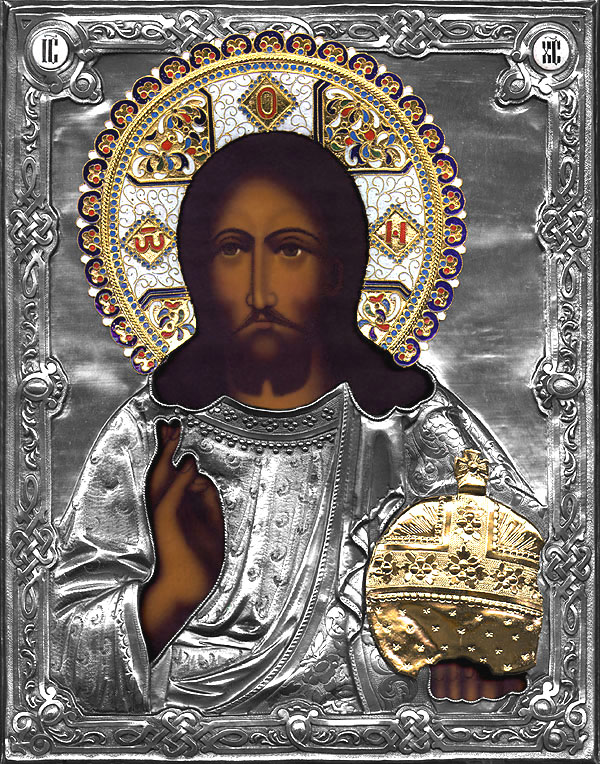
CHRIST - PANTOKRATOR

Fr. Anthony Zimmerman, S.T.D.

--------------------------------------------------------------------------------

The Gospel announces in its inimitable style of controlled wonder that Christ raised people from the dead when the occasion called for it. Paul suggests that Christ did even more than raise up people who had died. He implies that it was Christ who decided upon our creation, upon our coming to life in the first place. Ashen corpses sprang to life, glazed eyes opened and blinked, when Christ called out: "Talitha kumi;" or, "Young man, I say to you, arise;" or "Lazarus, come forth." Paul excites our wonder equally by his fleeting revelation that God brought life to our bodies in the first place through Christ Jesus, 'ere time began. We know indeed that the human nature of Christ did not exist outside of its causes before the happy event of the Incarnation; before that historic moment celebrated by the entrance song of the Second Sunday after Christmas: "When peaceful silence lay over all, and night had run half of her swift course, your all-powerful word, O Lord, leaped down from heaven." Yet we also know that the Church recognizes that Christ worked even before His birth into the confines of time. The prime example of this is Mary's Immaculate Conception: before Christ was conceived, He already sanctified His Mother. "By a singular grace and privilege of Almighty God, in virtue of the merits of Christ Jesus, the Savior of the human race" (DS 1641) she was conceived Immaculate. Indeed, all peoples since Adam who received grace, received it through Christ (see e.g. Heb 11:39-40; Reading, Liturgical Hours, Holy Saturday). And Paul tells us that the spiritual Rock from which the Israelites drank during their desert wanderings was none other than Christ (1 Cor 10:4).

Peter informs us that Christ was active in the Old Testament prophets through the Spirit which He gave to them: "They investigated the times and the circumstances which the Spirit of Christ within them was pointing to, for he predicted the sufferings destined for Christ and the glories that would follow" (1 Pet 1:11). In other words, the Spirit, whose salvific works were to be merited by Christ to do the works of salvation in the Old Testament times, did not wait to do these works until Christ was born in time. The gifts of the Spirit, still to be merited by Christ, were already inspiring the prophets who foresaw Christ's life.


AT BIRTH CHRIST KNEW HIS PAST RECORD


Christ's comprehensive knowledge of the universe from the time of the Incarnation made Him humanly aware of the work which His soon-to-be-acquired merits had already done in the past; we likewise conclude that He offered Himself freely to accept God's will in this respect retroactively (cf. Heb 10:5-7; 5:7). St. Thomas observes that Christ, in His created human nature, comprehended the entire cosmos by way of the beatific vision, and by the light of created infused knowledge (see Summa Theologica III, 9:3; 10:2-3; 11:2,5; see discussion in THE PRIEST, Sept. 1993). His knowledge thus comprehended all things created from the beginning of time; this necessarily included, therefore, all the salvific activities which He had been performing, through the power of the Spirit, long before He saw the light of day in Bethlehem. He recognized and approved now, after His birth, all the works which He already performed since the beginning of time. He Himself was the raison d'etre of this universe into which He now entered with a human body and soul.


CHRIST: THE ALPHA AND OMEGA OF CREATION


Paul instructs us that God made our existence take its origin in Christ Jesus as our Alpha; that God created all things in and through the First Born, the Incarnate Christ; through that same Christ who is now fully in charge of this universe; who, when He will finalize His work of submitting the cosmos to Himself, will deliver it back to God: "When everything is subjected to him, then the Son himself will [also] be subjected to the One who subjected everything to him, so that God may be all in all" (1 Cor 14:28).


By means of His beatific vision and His infused knowledge Christ was perfectly aware that this universe had always been His own, that He is now its steward and has always been so; He could interface His beatific vision and infused knowledge with His experiential human awareness. The music of eternity now flowed to the beat of rhythmic time; His direct view of God was background to events experienced by His senses as He marched over the hills of Galilee.


At last on earth itself, Christ now embraced with His free will the events in which God had already engaged Him before time began. He did this in the light of the beatific vision which ever bathed His created mind, a vision in which all creation was displayed; He could call to the console of His experiential awareness His infused knowledge of the cosmos, and focus strands of this light on this or that event to enhance cerebral awareness. He experienced daily events with human perceptions, whose meaning He evaluated in the brighter lights of vision and infused knowledge.


The teachings of Thomas about Christ's knowledge fit smoothly into the insight of Paul who wrote to Timothy that Christ "saved us and called us to a holy life ... according to his own design and the grace bestowed on us in Christ Jesus before time began" (2 Tim 1:9). A closer look at the passage allows us to see a line of progression from the design initiated by God, to the elaboration of that design performed in Christ Jesus. "... secundum propositum suum, et gratiam, quae data est nobis in Christo Iesu ante tempora saecularia." The Propositum (in Greek "prothesin") is attributed to God, and the gratia (Greek "charin") is described as mediated to us in Christ Jesus. God proposes, but works out the proposal in the context of the consenting Christ. The manifestation in time, of events prefabricated in eternity, aroused wonder in Paul:


Praised be the God and Father of our Lord Jesus Christ, who has bestowed on us in Christ every spiritual blessing in the heavens! God chose us in him before the world began, to be holy and blameless in his sight, to be full of love...


God has given us the wisdom to understand fully the mystery, the plan he was pleased to decree in Christ, to be carried out in the fullness of time: namely to bring all things in the heavens and on earth into one under Christ's headship (Eph 1: 3-4;9-10).


The creation decision, then, is of God, and its actualization is done with the by-standing cooperation of the God-man. God, then, decided upon our individual creation not in the context of a mindless universe, but "in Christ Jesus before time began." Christ is the Alpha as well as the Omega of creation. Nothing happened in this universe except through Christ's engagement.


This passage of Paul is not a misprint of Sacred Scripture, but is a key to a more profound understanding of Christ Jesus as Pantokrator, the One to whom we owe not only our salvation, but our lives. Paul wrote to the Ephesians in the same euphoric outpouring: "For we are his handiwork, created in Christ Jesus for the good works that God has prepared in advance, that we should live in them" (Eph 2:10). The Christ Jesus in whom we were created is assuredly here the Incarnate Christ, the God-man. It is the same Christ who was born in Bethlehem, who died on the cross. Somehow God fashioned us within the framework of Christ, of His knowledge and free choice. We are creatures who have been planned beforehand in Christ, a plan which was made even before Christ was born at Bethlehem.


Paul dwells on this mystery in the Letter to the Colossians: "For in him [in the God-man] were created all things in heaven and on earth, the visible and the invisible" (Col 1:16). That Paul here refers to the God-man may not be entirely clear, yet in the context that seems to follow. A few lines on down Paul describes the very same subject functioning as the "Head of the body, the church. He is the beginning, the firstborn from the dead" (Col 1:18).


CREATOR BY DIVINE POWER: DESIGNER IN FORESEEN HUMAN NATURE


The author of Hebrews ascribes to the God-man the creative wisdom and power of the Son of God, without distinguishing technically between Christ's powers as Creator and Redeemer: He is equally the reflection of the Father's glory, and the Redeemer who cleansed us of our sins:


In times past, God spoke in partial and various ways to our ancestors through the prophets; in these last days, he spoke to us through a son, whom he made heir of all things and through whom he created the universe, who is the refulgence of his glory, the imprint of his being, who sustains all things by his mighty word. When he had accomplished purification from sins, he took his seat at the right hand of the Majesty on high, as far superior to the angels as the name he has inherited is more excellent than theirs. (Heb 1:1-4).


We see in the passage that the Christ who redeemed us is also the One through whom God created all things. He, who now reigns at the right hand of the Majesty on high, is the same Christ through whom God created the cosmos. He is as superior to Moses, as the "founder of the house has more honor than the house itself" (Heb 3:3). Hebrews does not spell out in technical or theological terms what may be the meaning of the phrase "through whom he created the universe."


We know, however, than only God can create, because drawing existence out of nothing requires divine power; God cannot delegate the task of creation to any creature. Neither would the Son of God create things through His human powers, that being impossible. We assume therefore that the meaning of "creating the universe in Christ," means first of all that the Son created all things with the Father and the Spirit; and secondly that when Father, Son, and Spirit created, they first set forth the Key to the rest of creation, namely Christ in His human nature; and then shaped the cosmos in accord with the model or blue print of its First Born, namely Christ. Christ in His human nature is creation's Alpha; all other things come from God through Him. The sky would be the roof which the God-man Christ should like to see; the earth should produce the flowers and seeds which Joseph would name for Him; the Mother who should bear Him and love Him should be the Woman, the co-Redemptrix, who would trample the head of the serpent with Him. God, in carrying out creation, measured all things to accord with the needs and plans and wisdom and will of Christ, the God-man. This God-man was already at God's side in eternity, even though His manifestation in time was not yet perceived by creatures who are time-bound.


We might, therefore, distinguish the WORK of creation which is done by God only, by Father, Son, and Spirit, one divine power; and the SHAPING of this creation, a task in which Christ participates with His human wisdom and free choice. And so we may dare to paraphrase John 1:3 to describe this joint action: "All things came to be through him [through God]; and without him [Christ] nothing came to be measured and put into shape."


A passage of Proverbs presents a magnificent description of personified Wisdom present to God during the work of creation. We see here a vision of Christ standing at God's side to give shape to the cosmos while God commands it into being:


When he established the heavens I was there when he marked out the vault over the face of the deep; When he made firm the skies above, when he fixed fast the foundations of the earth; When he set for the sea its limit, so that the waters should not transgress his command; Then was I beside him as his craftsman, and I was his delight day by day, Playing before him all the while, playing on the surface of the earth; and I found delight in the sons of men (Prov. 8: 27-31).


Christ, knowing that He was God's craftsman, the One who always stood by to give proper shape to the cosmos, knew well all the secrets of creation and the deepest yearnings of the human soul. His advice will always be best, because this Master Architect knows the purpose of all things made. In the Gospel Christ could only weep when Jerusalem did not take advantage of His coming, (cf. Lk 20:41 ff.). It is the artist weeping when insensitive people ignore the beauty and limpid rationality of His cosmos. The Church, on the contrary, does its best to make up for the world's insensitivity, by recognizing Christ's unique cosmic centrality when blessing the Easter Candle on Holy Saturday:


Christ yesterday and today the beginning and the end Alpha and Omega all time belongs to him and all the ages to him be glory and power through every age and ever. Amen.


ADAM'S GRACE: GRATIA DEI OR GRATIA CHRISTI?


That God constituted our Adam and Eve in the state of holiness and justice before their Fall is a dogma of faith, firmly fixed into the platform of belief on which we stand. That Christ came to redeem us after the Fall is also central to our faith. But whether it was Christ the God-man who gave Adam and Eve their initial gifts of holiness and justice before the Fall, is a celebrated controversy among theologians, both giants and amateurs.


One side of the controversy claims that God decreed the Incarnation of Christ only subsequent to the pre-view of the Fall of Adam and Eve; the logic of this view implies that Adam and Eve owed nothing to Christ for their original gifts of holiness and justice, and that their relations with Christ began only after their sin, when Christ was decreed to redeem them.


The other party affirms that Christ is first, last, and forever the King and Lord of the universe; that Christ gave the original gift of holiness and justice to our first parents; and that He took it upon Himself to redeem them after they had lost His initial endowment. This party makes Christ to be the first step in the divine decree of any creation whatsoever. As Blessed Duns Scotus (d. 1308) expressed it subtly in this lapidary sentence, God decided to receive glory from outside of Himself, to be given to Him by none other than the God-man. And for this purpose He decreed first the Incarnation, then the universe by means of which the God-man would return glory to God:


God first loves himself; secondly, He loves Himself for others, and this is an ordered love; thirdly, He wishes to be loved by the One who can love Him in the highest way—speaking of the love of someone who is extrinsic to Him; and fourthly, He foresees the union of that nature which must love Him with the greatest love even if no one had fallen (Opus Par. III, d.7, q.4; see Pancheri-Carol, The Universal Primacy of Christ, Christendom Publications, 1984, p. 35).


By no means does either party of this theological controversy deny Christ's Kingship in the present world, which is the world after the Fall. From the moment God decreed that the Son should become Incarnate, whether He decreed Christ as a response to Adam's sin, or whether God made Christ to be the first step in the order of any and all creation; in either case, Christ alone is now Lord and King of the Universe.


I have trouble with disputants who make Christ a "Johnny-come-late" into the universe. My trouble begins as follows. I seem to be God's "second choice." God really wanted His first plan to succeed, which was a world without Christ. But Paul announced that you and I were chosen and created "in Christ."


Would we have been left out of the banquet of life if Adam had not sinned, and if Christ had not been decreed? We who are taught by the Church to pray:


Praised by the God and Father of our Lord Jesus Christ, who has bestowed on us in Christ every spiritual blessing in the heavens. God chose us in him before the world began to be holy and blameless in his sight. (Liturgy of the Hours, from Eph 1:3-5).


If God had a first plan which then failed; a plan by which He supposedly created Adam and Eve and constituted them in holiness and justice without the mediation of Christ (gratia Dei); then it follows that we, who are now created "in Christ," may be God's "second choice;" we were not considered in the first and foiled plan. Would we have been created at all if the first plan had succeeded? If God planned that universe originally without Christ as its Alpha and Omega; and if, as Paul says, you and I, who are now God's handiwork "created in Christ Jesus;" then would God have created you and me at all within the framework of a supposed Christless universe? By winning this argument, theologians may have to confess that they are God's "second choice."


Furthermore, the controverted theory of a once-planned Christless universe has a flaw which appears quite absurd: we should be obliged to thank Adam and Eve for offending God by their sin, the sin which then made our creation possible by occasioning God's second choice. Scotus, with a wry sense of humor, notes that if Christ would not have become incarnate unless Adam sinned, then the Son of God should have been sorry if Adam obeyed, but glad if he sinned. "Christ would have rejoiced over Adam's prevarication, since He would have owed His Incarnation to it" (cf. Ordinatio, III, d.7; cited in Pancheri-Carol, p. 39).


A second thought raises grave doubts about a so-called plan for a Christless universe. Trent defined, in 1546, that God constituted Adam in holiness and justice (DS 1511); we necessarily conclude from this dogma the further truth that God also revealed Himself to our first parents. It would be absurd for God to destine Adam and Eve for eternal life in heaven, without revealing to them that it is He Himself who calls them to heaven; and without revealing to them the original "ten commandments of the Garden of Eden." The first chapters of Genesis tell beautifully the story of God's revelation to our first parents.


In the beginning He created the heavens and the earth; He made the light, the dome of the sky, the expanded seas and the dry land; He made every kind of plant and the fruit trees; also the lights in the dome of the sky, both the greater one to govern the day and the lesser one to govern the night, and the stars; He made the waters teem with life, and the skies He filled with all kinds of winged birds; then He made cattle, creeping things, and wild animals of all kinds; finally He said:


Let us make man in our image, after our likeness. Let them have dominion over the fish of the sea, the birds of the air, and the cattle, and over all the wild animals and all the creatures that crawl on the ground. God created man in his image; in the divine image he created him; male and female he created them. God blessed them, saying: "Be fertile and multiply; fill the earth and subdue it" (Gen 1: 26-28).


Genesis contains more basic initial instructions: God planted for man a garden and kept company with him there; He showed man how to work, gave him the command to do good and avoid evil, and joined them in monogamous marriage. Even though it is not likely that God gave these instructions to our first parents in this exact form, we do have to accept that God most certainly revealed Himself to our first parents in a manner which enabled them to know God, to love Him, and to serve Him in this world, and so to merit being happy with Him forever in the next.


This primeval revelation, we believe, was given in its basic form to our first parents as part of the package of the gift of holiness and justice. For God, in His Wisdom, would not elevate them to the supernatural state without providing them with suitable instructions about the nature of that state, and their corresponding duties. This theological implication that the God who elevated our Adam and Eve, also instructed them with revelation, is strangely missing not only in the documents of Trent, but, so far as I know, in the relevant theological and anthropological literature which treats of the origin of the human race, and of our salvation. Yet this theological conclusion by itself is sufficient to refute all the arguments which imply that man evolved in religious belief from polytheism to monotheism. Decidedly our Adam was monotheistic, because God revealed Himself to him when He called him to an eternal destiny in heaven.


Brighter minds than my own may see their way clear to assert that this first grace given to Adam was gratia Dei, not gratia Christi; logically they must also assert that the first revelation was also revelatio Dei, not a revelation mediated by Christ. By their logic we should then divide the text of Genesis into two parts: Part One, the revelation made by God to Adam before his Fall, that is, before Christ was decreed; Part Two, the revelation made to Adam after the Fall when Christ was decreed after Adam had sinned.


To me it appears that the Scriptures are best explained by assuming that the original grace, and the original revelation, were mediated to Adam by Christ who had been decreed from the beginning of creation, without reference to the foreseen sin of Adam; that it was Christ who elevated our Adam and Eve with the original supernatural gifts of holiness and justice; who also saved them after the Fall; who also governed the world from above until the fullness of time came when He appeared in Person in Bethlehem, and wrought our redemption in Jerusalem. The whole of Scripture appears to point in that direction more than to the other (but see Thomas ST III,1,3, who leans to the opinion that the Scriptures appear to teach that Christ came in response to the need for Redemption as occasioned by Adam's sin).


Solomon saw in the Spirit that Personified Wisdom - read Christ - shepherded Adam from the beginning, at the time of his creation, and lifted him once more after the fall:


She (Wisdom) preserved the first formed father of the world when he alone had been created; And she raised him up from his fall, and gave him power to rule all things (Wis 10:1-2).


We ought not attach theological precisions to this poetry attributed to Solomon - probably not really his - but we see how fittingly this passage expresses what we already find to be reasonable; namely that Christ guarded Adam from the beginning.


CONCLUSION


We offer Christ faint and inadequate praise if we honor Him as the Redeemer whose function is reductively spiritual, but fail to recognize Him as ruler of the cosmos. We view Christ narrowly if in our small minds we consign His Kingship to the sacristy and church, but keep Him out of the marketplace. For He is now King of the universe, whether He came in response to the sin of Adam, or whether He stood by to assist in the design of the cosmos in the first place. In either case, the cosmos is His from end to end, from sea to shining sea, from plain to mountain, from pole to pole and around the circle of the equator; to Him belong all government, His are the workings of the economy, His the psychology of the human mind, His any true statistics compiled by demographers and sociologists; His is the art of medicine insofar as it is not abused by unprincipled manipulators of His creation; He is Master of culture, of human dress and styles, of the dance, of poetry, of art, of drama, entertainment, the circus; of tourism, of diplomacy, even of just wars; He has been active in all human history which belongs to Him; His are the times past, present, AND future; His is the key which opens the door when men pass from this world to the next.


In principle we refrain from coercing people to practice the true religion; but we also recognize the principle that both Church and State belong equally to Christ. To do justice and honor to Christ, we must endeavor to help Him shape the State to conform freely to His eternal laws. Individuals, families, nations, the United Nations, Village Earth - all owe their existence to Christ, all are obliged to obey Him, to keep His laws, and to conform themselves to truth. Individuals are bound to do this individually, collectivities are also bound to do this collectively. For Christ is not our Redeemer only; He is the Pantokrator, the almighty ruler of the cosmos, the One "through whom (God) first created the universe" who "sustains all things by his powerful word" (Heb 1:2,3).


--------------------------------------------------------------------------------

Published in Faith & Reason, Fall 1994.

Reprinted with permission from Fr. Zimmerman.

Further of his writings may be found at

http://zimmerman.catholic.ac/

--------------------------------------------------------------------------------

Electronic Copyright © 2000 EWTN

All Rights Reserved


Provided Courtesy of:

Eternal Word Television Network

5817 Old Leeds Road

Irondale, AL 35210

www.ewtn.com


HOME-EWTNews-FAITH-TELEVISION-RADIO-LIBRARY-GALLERY-CATALOGUE-GENERAL

ESPAÑOL


Sunday, September 9, 2012

Archaeologists unearth ancient Bethlehem seal


JERUSALEM – Israeli archaeologists have discovered a 2,700-year-old seal that bears the inscription "Bethlehem," the Israel Antiquities Authority announced Wednesday, in what experts believe to be the oldest artifact with the name of Jesus' traditional birthplace.


The tiny clay seal's existence and age provide vivid evidence that Bethlehem was not just the name of a fabled biblical town, but also a bustling place of trade linked to the nearby city of Jerusalem, archaeologists said.

Eli Shukron, the authority's director of excavations, said the find was significant because it is the first time the name "Bethlehem" appears outside of a biblical text from that period.


Shukron said the seal, 1.5 centimeters (0.59 inches) in diameter, dates back to the period of the first biblical Jewish Temple, between the eighth and seventh century B.C., at a time when Jewish kings reigned over the ancient kingdom of Judah and 700 years before Jesus was born.


The seal was written in ancient Hebrew script from the same time. Pottery found nearby also dated back to the same period, he said.


Shmuel Achituv, an expert in ancient scripts at Israel's Ben-Gurion University who did not participate in the dig, said the discovery was the oldest reference to Bethlehem ever found outside of the Bible. Apart from the seal, the other mentions of Bethlehem, Achituv said, "are only in the Bible."


The stamp, also known as "fiscal bulla," was likely used to seal an administrative tax document, sent from Bethlehem to Jerusalem, the seat of Jewish power at the time.


It was found as archaeologists sifted through mounds of dirt they had dug up in an excavation outside Jerusalem's Old City walls.


Shukron said the first line most likely read "Beshava'at" -- or "in the seventh" -- most likely the year of the reign of a king. The second line, he said, has the crumbling letters of the word "Bethlehem." The third line carried one letter, a "ch" which Shukron said was the last letter of the Hebrew work for king, "melech."


Hebrew words often do not have vowels, which are understood from the context, making several interpretations of the same word plausible. Some of the letters are crumbled, or were wiped away. Three experts interviewed by the AP, one involved in the text and two independents, concurred the seal says Bethlehem.


There are only some 40 other existing seals of this kind from the first Jewish Temple period, said Achituv, making this a significant find, both because such seals are rare, and because this is the first to mention Bethlehem.


The dig itself has raised controversy.


It is being underwritten by an extreme-right wing Jewish organization that seeks to populate the crowded Palestinian neighborhood of Silwan with Jewish settlers, arguing that they have ancient links to the area. The dig is being undertaken in a national park in the area of Silwan, known to Jews as "the City of David."


Shukron said the seal was found some months ago, but they needed time to confirm the identity of the artifact.


....


Wednesday, August 29, 2012

“A Star … out of Jacob”


For full article, see:


Chapter Three: “A Star … out of Jacob”


Let us now turn again to the method of inferences from harmonies, that we have used in the last two chapters, in order to determine, with greater precision than has been attained do far, the date of Our Lord’s Nativity. Despite Scaliger, who said that God alone, not man, can determine the true day of the Nativity (Scaliger, as quoted by Hales, Chron., Vol. 1, p. 199), we are prepared to accept a result arising clearly and consistently from the method of harmonies – should such a result be achieved – provided, of course, that the result does not clash with, or contradict, any well–established fact of history. And we can look upon this further application of the method of inferences from harmonies as being a further test of the reliability of this method of inference.

We shall investigate historical methods later on. [Actually the needed revision of late BC-early AD history, not yet effected, may be far more radical than earlier writers, like Mackinlay, could possibly have imagined. See other AMAIC articles on the revision of history and chronology, including now the beginnings of a revision of early Roman Imperial history]. As Mackinlay saw it, it was universally accepted that Our Lord’s Nativity could not have been earlier than the beginning of BC 10, or later than the end of BC 5. The date is today generally given as being somewhere between BC 7-6. In pursuing these new inferences now for the earlier part of Our Lord’s life, we once again follow our reliable guide Mackinlay who commences by establishing “the greater probability” of the following two facts:


(a) That the Nativity of Our Lord was at least five months after the beginning of a period of shining of the morning star, and,


(b) That the Nativity was at a Feast of Tabernacles (p. 140).


Firstly, we investigate Mackinlay’s reason for believing that our Lord’s Nativity was:


(a) Five months after a period of shining.

To begin with, we must consider what reason there is for supposing that the morning star was shining at all when Our Lord was born. In Malachi 3:1, as we have seen already, St. John the Baptist is referred to under the figure of the morning star, as the forerunner of the Christ. But the morning star itself may be called “My messenger who shall prepare the way before Me”. It is not unusual for inanimate objects thus to be spoken of in Scripture, for instance in Psalm 88:38 we have “the faithful witness in the sky”, and in Psalm 148:3 the sun, moon and stars of light are exhorted to praise God. Consequently, as Mackinlay has explained it (p. 141), “we can reasonably suppose that the Morning Star was shining at the Nativity”. Furthermore, he adds, if the morning star were the herald of the coming One, it is fitting to imagine that a somewhat prolonged notice should be given; for “it would be more dignified and stately for the one to precede the other by a considerable interval, than that both should come almost together”.

We shall find Mackinlay’s supposition of a prolonged heralding by the morning star borne out by the following inference. According to the principle of metaphors being taken from things present, we could infer that the morning star was actually shining when Our Lord (in Matthew 11:10), quoting Malachi 3:1, spoke of the Baptist as “My messenger … before My face”. Consistently following the same line of thought, we may reasonably infer that the morning star was also shining more than thirty years earlier when Zechariah quoted the same scriptural verse – i.e. Malachi 3:1 – at the circumcision of his son, John (Luke 1:76). Even had this appropriate passage not been quoted at the time, Mackinlay suggests (p. 142), “we might have inferred that the herald in the sky would harmoniously have been shining at the birth of the human herald”.

st1\:* { BEHAVIOR: url(#ieooui) }

@page Section1 {size: 612.0pt 792.0pt; margin: 72.0pt 90.0pt 72.0pt 90.0pt; mso-header-margin: 36.0pt; mso-footer-margin: 36.0pt; mso-paper-source: 0; } P.MsoNormal { MARGIN: 0cm 0cm 0pt; FONT-FAMILY: "Times New Roman"; FONT-SIZE: 12pt; mso-style-parent: ""; mso-pagination: widow-orphan; mso-fareast-font-family: "Times New Roman"; mso-fareast-language: EN-US } LI.MsoNormal { MARGIN: 0cm 0cm 0pt; FONT-FAMILY: "Times New Roman"; FONT-SIZE: 12pt; mso-style-parent: ""; mso-pagination: widow-orphan; mso-fareast-font-family: "Times New Roman"; mso-fareast-language: EN-US } DIV.MsoNormal { MARGIN: 0cm 0cm 0pt; FONT-FAMILY: "Times New Roman"; FONT-SIZE: 12pt; mso-style-parent: ""; mso-pagination: widow-orphan; mso-fareast-font-family: "Times New Roman"; mso-fareast-language: EN-US } P.MsoBodyText { TEXT-ALIGN: justify; MARGIN: 0cm 0cm 0pt; FONT-FAMILY: "Times New Roman"; FONT-SIZE: 12pt; mso-pagination: widow-orphan; mso-fareast-font-family: "Times New Roman"; mso-fareast-language: EN-US } LI.MsoBodyText { TEXT-ALIGN: justify; MARGIN: 0cm 0cm 0pt; FONT-FAMILY: "Times New Roman"; FONT-SIZE: 12pt; mso-pagination: widow-orphan; mso-fareast-font-family: "Times New Roman"; mso-fareast-language: EN-US } DIV.MsoBodyText { TEXT-ALIGN: justify; MARGIN: 0cm 0cm 0pt; FONT-FAMILY: "Times New Roman"; FONT-SIZE: 12pt; mso-pagination: widow-orphan; mso-fareast-font-family: "Times New Roman"; mso-fareast-language: EN-US } DIV.Section1 { page: Section1 } OL { MARGIN-BOTTOM: 0cm } UL { MARGIN-BOTTOM: 0cm }


Mackinlay further suggests from his inference that both Our Lord and St. Johnwere born when the morning star was shining, that “both must have been born during the same period of its shining”. [He shows this in his charts]. The Annunciation to Mary was made by the angel Gabriel in the sixth month after the announcement to Zechariah (Luke1:13, 24, 26); and so it follows that the Baptist was born five to six months before Our Lord. Since Mackinlay’s charts indicate that the periods of shining are separated from each other by intervals of time greater than six months, then both Our Lord and his herald must have been born during the same period of shining.


Consequently Our Lord was born at least five months after the beginning of a period of shining of the morning star.


It will be noticed that some years in Mackinlay’s charts are omitted – this is due simply to lack of space – but no events recorded in the Gospels took place in these omitted years, nor were any of them enrolment (see below) or Sabbath years.


The chart contain both the time scales of seven and eight years as previously discussed – viz. the weeks of years and the octave of years of the cycle of the periods when the morning star was shining. For the sake of simplicity, the periods of the shinings of the evening star are omitted. Also, Mackinlay has inserted the cycle of the enrolments every fourteen years that were enforced by the Roman government throughout the settled areas of its empire. These enrolment years are indicated by ovals marking the years BC 8-7 (tentatively), and also AD 7-8, and AD 21-22. As the first of these enrolments, BC 8-7, was carried out in modified form inPalestine, the outline of the oval is lighter than are those of later years; these years began at about the vernal equinox.


(a) At a Feast of Tabernacles


The Law, we are told by St. Paul, has “a shadow of the good things to come” (Hebrews 10:1). The various ordinances and feasts of the Old Testament, if properly understood, are found, according to Mackinlay, “to refer to and foreshadow many events and doctrines of the New Testament” (p. 143). Again, A. Gordon remarks that: “Many speak slightingly of the types, but they are as accurate as mathematics; they fix the sequence of events in redemption as rigidly as the order of sunrise and noontide is fixed in the heavens” (The Ministry of the Spirit, p. 28). The deductions drawn from Gospel harmonies attest the truth of his statement.


We have already observed that the Sabbath Year began at the Feast of Tabernacles; the great feasts of Passover and Weeks following in due course. Our Lord’s death took place at the Passover (Matthew 27:50), probably, Mackinlay believes, “at the very hour when the paschal lambs were killed”. “Our Passover … has been sacrificed, even Christ” (1 Corinthians 5:7); the great Victim foretold during so many ages by the yearly shedding of blood at that feast. The first Passover at the Exodus was held on the anniversary of the day when the promise – accompanied by sacrifice – was given to Abraham, that his seed would inherit thelandofCanaan(Exodus12:41; Genesis 15:8-18).


Our Lord rose from the dead on the day after the Sabbath after the Passover (John 20:1); the day on which the sheaf of first fruits, promise of the future harvest, was waved before God (Leviticus 23:10, 11). Hence we are told bySt. Paulthat as “Christ the first-fruits” (1 Corinthians 15:20. 23) rose, so those who believe in him will also rise afterwards. This day was the anniversary of Israel’s crossing through the Red Sea or “Sea of Reeds’ (Exodus 12-14), and, as in the case of the Passover, it was also a date memorable in early history, being the day when the Ark came to rest on the mountains of Ararat (Genesis 8:4). The month Nisan, which had been the seventh month, became the first at the Exodus (Exodus 12:2). Thus Our Lord’s Resurrection was heralded by two most beautiful and fitting types, occurring almost – possibly exactly – on the same day of the year; by the renewed earth emerging from the waters of the Flood, and by the redeemed people emerging from the waters of the “Sea of Reeds”.


The next great event of the Christian dispensation, the Descent of the Holy Spirit (Acts 2:1, 2), occurred at the Feast of Weeks – or Harvest – or Pentecost (Leviticus23:15, 16). It was during this season that the Law had been given to Moses onMount Sinai(Exodus 19:1, 10, 11). It is noteworthy, therefore, that the inauguration of the New Covenant took place on the anniversary of the establishment of the Old Covenant; showing that the dispensation of Law was superseded by that of the Holy Spirit (Hebrews 8:7; 2 Corinthians 3:6).


Accordingly, “since there is such manifest deign in the timing of Our Lord’s Death and Resurrection and of the descent of the Holy Spirit”, Mackinlay suggests that “the Nativity may well have occurred at the remaining great Feast of the Lord – at that of Tabernacles, which began the Sabbath Year” (p. 145). Having said this, Mackinlay proceeds to search for any harmonies that there may be between the characteristics of this Feast of Tabernacles and the events recorded in connection with the Nativity. As we have noticed previously, he says (p. 146), there were two great characteristics of the Feast of Tabernacles: 1. Great joy and 2. Living in booths (tents).


1. Great joy.


The Israelites were told at this feast, “You shall rejoice before the Lord your God” (Leviticus23:40), and “You shall rejoice in your feast … you shall be altogether joyful” (Deuteronomy16:14, 15). King Solomon dedicated hisTempleon a Feast of Tabernacles, and the people afterwards were sent away “joyful and glad of heart” (1 Kings 8:2, 66; 2 Chronicles7:10).


There was no public rejoicing at the Nativity of Our Lord, however; on the contrary, as Mackinlay notes, “shortly afterwards Herod was troubled and allJerusalemwith him” (Matthew 2:3)”. But though Our Lord was rejected by the majority, we find the characteristic joy of Tabernacles reflected in the expectant and spiritually-minded souls. Before the Nativity both the Virgin Mary and Elizabeth rejoiced in anticipation of it (Luke1:38, 42, 44, 46, 47). At the Nativity an angel appeared to the shepherds and brought them good tidings of great joy; and then “suddenly there was with the angel a multitude of the heavenly host praising God, and saying, ‘Glory to God in the highest’.” The shepherds then came to the infant Saviour and returned “glorifying and praising God” (Luke 2:9-20).


Forty days after the Nativity, at the Purification, Simeon, who had been waiting a long time for the consolation of Israel, and the venerable Anna who was a constant worshipper, joined in with their notes of praise and gladness (Luke 2:22-38). And lastly the wise men from the East “rejoiced with exceeding great joy” when they saw the star indicating where the Saviour was, and they came into the house, saw the young Child with his Mother, and presented the gifts that they had brought (Matthew 2:9-11).


2. Living in Booths.


The command given to the Israelites concerning the observance of the Feast of Tabernacles was: “You shall dwell in booths for seven days” (Leviticus23:42). We also read, “In the feast of the seventh month … all the congregation … made booths, and dwelt in the booths” (Nehemiah8:14, 17).


According to Mackinlay (pp. 147-148), the living in booths finds a parallel in the language of the Apostle John, when he wrote concerning the Birth of Our Lord, “The Word became flesh, and tabernacled among us” (John 1:14); and Our Lord himself used a somewhat similar figure when he spoke of his body thus “Destroy this Temple, and in three days I shall raise it up” (John 2:19) – words misunderstood by his enemies and afterwards quoted against him (Matthew 26:61; 27:40).


It was at the Feast of Tabernacles that the glory of God filled the Temple that King Solomon had prepared for Him (2 Chronicles 5:3, 13, 14), and it would seem to have been at the beginning or first day of the feast, the fifteenth day of the month. Consequently, in Mackinlay’s opinion (p. 148) “it would appear to be harmonious that the Advent of the Lord Jesus in the body divinely prepared for him (Hebrews 10:5) should also take place at the same feast and most suitably on the first day of its celebration”.


st1\:* { BEHAVIOR: url(#ieooui) }

@font-face { font-family: Century; } @page Section1 {size: 8.5in 11.0in; margin: 1.0in 1.25in 1.0in 1.25in; mso-header-margin: .5in; mso-footer-margin: .5in; mso-paper-source: 0; } P.MsoNormal { MARGIN: 0in 0in 0pt; FONT-FAMILY: "Times New Roman"; FONT-SIZE: 12pt; mso-style-parent: ""; mso-pagination: widow-orphan; mso-fareast-font-family: "Times New Roman"; mso-ansi-language: EN-AU } LI.MsoNormal { MARGIN: 0in 0in 0pt; FONT-FAMILY: "Times New Roman"; FONT-SIZE: 12pt; mso-style-parent: ""; mso-pagination: widow-orphan; mso-fareast-font-family: "Times New Roman"; mso-ansi-language: EN-AU } DIV.MsoNormal { MARGIN: 0in 0in 0pt; FONT-FAMILY: "Times New Roman"; FONT-SIZE: 12pt; mso-style-parent: ""; mso-pagination: widow-orphan; mso-fareast-font-family: "Times New Roman"; mso-ansi-language: EN-AU } P.MsoBodyText { TEXT-ALIGN: justify; MARGIN: 0in 0in 0pt; FONT-FAMILY: "Times New Roman"; FONT-SIZE: 12pt; mso-pagination: widow-orphan; mso-fareast-font-family: "Times New Roman"; mso-ansi-language: EN-AU } LI.MsoBodyText { TEXT-ALIGN: justify; MARGIN: 0in 0in 0pt; FONT-FAMILY: "Times New Roman"; FONT-SIZE: 12pt; mso-pagination: widow-orphan; mso-fareast-font-family: "Times New Roman"; mso-ansi-language: EN-AU } DIV.MsoBodyText { TEXT-ALIGN: justify; MARGIN: 0in 0in 0pt; FONT-FAMILY: "Times New Roman"; FONT-SIZE: 12pt; mso-pagination: widow-orphan; mso-fareast-font-family: "Times New Roman"; mso-ansi-language: EN-AU } DIV.Section1 { page: Section1 } OL { MARGIN-BOTTOM: 0in } UL { MARGIN-BOTTOM: 0in }


It will be noticed that the glory of God did not cover the tent of meeting when the Israelites were in the wilderness, and did not fill the tabernacle, at the Feast of Tabernacles. But it did so on the first day of the first month of the second year after the departure fromEgypt(Exodus 40:17, 34, 35). We must remember that there was no Feast of Tabernacles in the wilderness, nor was the Sabbath Year kept at this stage; but both of these ordinances were to be observed when the Israelites entered into the Promised Land (Exodus 34:22). No agricultural operations were carried out during the forty years of wandering in the wilderness.


As the Feast of Tabernacles inaugurated the Sabbath Year, Mackinlay judged (p. 149) that the glory of God filled the temple on the first day of the feast, “as that would be in harmony with what happened in the tabernacle in the wilderness when the glory of the Lord filled it on the first day of the only style of year then observed”. A. Edersheim, writing about the Feast of Tabernacles, says (The Temple, note on p. 272): “It is remarkable how many allusions to this feast occur in the writings of the prophets, as if its types were the goal of all their desires”.


Having come thus far, we are able - within Mackinlay’s context - to arrive at a still tentative, but very reasonable, conclusion: and this conclusion will later be strengthened very greatly, particularly when we look at the historical facts. Mackinlay at this stage analyses those years, BC 10-5, which are universally accepted as being the only possible ones for the date of Our Lord’s birth, to determine which of them fits the best (p. 150). Since it has been inferred that the Nativity occurred at a Feast of Tabernacles – probably on the first day – and that the morning star had been shining by then for at least five months, a glance at Mackinlay’s chart informs us that the only year within the possible historical limits that satisfies these conditions, in his context, is BC 8.


For we will notice that at the Feast of Tabernacles – say the autumnal equinox – of:


BC 10, the morning star was only just beginning its period.


BC 9, there was no morning star at all.


BC 8, the conditions are satisfied completely.


BC 7, there was no morning star at all.


BC 6, there was no morning star at all.


BC 5, the morning star had been shining only for about four months previously.


According to Mackinlay, the Feast of Tabernacles, BC 8, presents the further harmony that it was specially suited to the occasion, “as it was the first after a Sabbath year, and consequently a specially joyful one”. Thus, he says (pp. 150-151), even if we neglect the consideration of the Morning Star, we still have the Feast of Tabernacles BC 8 indicated for the date of the Nativity by the method of Gospel harmonies with the Sabbath year”.


The Identification of the “Star in the East”


We now come to the difficult and intricate matter of identifying the star that the Magi saw in the East, and that ultimately led them to the place where Christ, his Mother and Joseph were (Matthew 2:1-12). Much has been written about this famous incident, and there have been proposed many varying identifications for the star. It has at various times been identified as a comet; a new star; a conjunction of planets; a supernova. St. Augustinesometimes argued that it was a regular star of the heavens (e.g. in Serm. Epiph.), at other times that it was a new star appearing, for instance in the constellation Virgo (Contra Faustum, Bk. 2, ch. 5 a med.). St. Thomas Aquinas, following Chrysostom, was more inclined to the view that the star of the Nativity was not a regular part of the heavenly system; but was a newly-created star (Summ. Theol. IIIa, q. 36, a. 7). But he did allow for other opinions: viz. that it was an angel or a visible manifestation of the Holy Spirit. He also quoted Pope St. Leo (Serm. de Epiph, 31), who wrote that the star must have been more bright and beautiful than the other stars, for its appearance instantly convinced the Magi that it had an urgent and important meaning.


We know from Scripture that the heavenly bodies were invested by God with a fourfold function: “… for signs, and for seasons, and for days, and years” (Genesis 1:14). The point of the “days and years” is obvious. The Hebrew word ‘moed’, translated as “seasons”, is used to indicate something fixed or appointed. When it is used of time, according to Ben Adam (Astrology, p. 49), “it is always a predetermined time – a time in which something predetermined is to happen”. It is never used in Scripture to denote any of the four seasons of the year. Already we have seen how God uses the various heavenly bodies for seasons in this sense, and for signs or symbols.


An understanding and study of God’s purpose and meaning in relation to the lights of the firmament is true astrology, as opposed to the divinely forbidden and foolish astrology that is fatalistic. Dr. E. Bullinger (Witness of the Stars, 1893) has shown that the constellations of the zodiac, when read in the correct (not popular) order, and with their original (not corrupted and later) designations, give us a condensed history of the fulfilment of the divine promise made in the Garden of the coming Deliverer, the seed of the Woman, and the crushing of the serpent’s head (Genesis 3:15). According to Bullinger, this truth of the witness of the stars is told in Psalm 19:1-4: “The heavens are proclaiming the glory of God; and the firmament shows forth the work of his hands .… No speech, no voice, no word is heard, yet their message goes out through all the earth, and their words to the utmost bounds of the habitable world”.


In the sign Virgo, where the true beginning lies for reading the circular zodiac (not in Aries, according modern belief) is the commencement of all prophecy in Genesis 3:15: “I will put enmity between you and the Woman, and between your seed and her seed. She shall crush your head, and you shall lie in wait for her heel”. Later prophecy identifies this Woman as being of the stock of Israel, the seed of Abraham, the line of David; and, further, She is to be a virgin: “Behold, a virgin shall conceive and bear a son, and shall call his name Immanuel” (Matthew’s inspired adaptation, in 1:23, of Isaiah 7:14).


The first constellation in Virgo is Coma, represented by a woman and child, and meaning “the desired”, or “the longed for”. We have the word used by the Holy Spirit in this very connection, in Haggai 2:7: “The DESIRE of all nations shall come”. Bullinger and others have suggested that it was in all probability the constellation of Coma in which “the Star of Bethlehem” appeared (op. cit., p. 36). He also recalls a traditional prophecy, well-known in the East, “carefully preserved and handed down, that a new star would appear in this sign [i.e. of Coma] when He whom it foretold should be born” (ibid., pp. 36-37).


This, he thought (ibid., p. 37), was doubtless referred to in the prophecy of Balaam the sorcerer, just prior to the entry of the Israelite host into the Promised Land; a prophecy “which would thus receive a double fulfilment, first of the literal “Star”, and also of the person to whom it referred”. Thus God spoke through Balaam (Numbers 24:17):


There shall come forth a star out of Jacob


And a sceptre shall rise out ofIsrael.


This two-fold repletion of an idea – where the two nouns in the first verse correspond effectively to the two nouns in the second verse (thus ‘star’ to ‘sceptre’, and ‘Jacob’ to ‘Israel’) – so characteristic of Hebrew and Canaanite literature, also points in this case to a two-fold fulfilment of the prophecy. These words were fulfilled in a minimised sense a millennium before Christ, during the reign of David, the sceptre ofIsrael, and descendant of Jacob. But the prophecy would not be properly and completely fulfilled until the time of the Incarnation and the Birth of the true Messiah, who would be known as the “Son of David”.


But, as Bullinger says (ibid., p. 31), “It is difficult to separate the Virgin and her Seed” in the prophecies. Therefore, the genius of Hebrew expression in allowing for a two-fold interpretation of this particular prophecy, opens the door for the fullest possible meaning to be deduced from these words. As the following words by Pope Pius XII (spoken to the crowds ofFatima on May 13, 1946) would imply, the words of the above prophecy, applicable to Our Lord, also have relationship to his Mother as Co-Redemptrix:


“Jesus is King throughout all eternity by nature and by right of conquest: through Him, with him, and subordinate to him, Mary is Queen by grace, by divine relationship, by right of conquest and by singular election”. (As quoted by Fr. Wm. Most, Mary in Our Life, p. 25).


Matthew (2:1-12) is the only Evangelist to narrate the incident of the star seen by the Magi, leading them to the Christ with his Mother, Mary, in David’s city ofBethlehem. What does Matthew tell us about this star? That the Magi had seen it in the East, calling it “His star”, and that it indicated that He was to be worshipped as King of the Jews (2:2). And, later, that Herod determined from the time when the star first appeared how old the Child was (2:7). Finally, Matthew narrates that the Magi were filled with joy when they saw the star, after their meeting with Herod, and that they followed the star which “went before them, till it came to rest over the place where the Child was” (2:10-11).


Two things are to be noted here. Contrary to popular belief, nowhere at all does Matthew say that the Magi followed the star from their own country toJudaea! He simply says that they saw the star in their own country, “in the East”, and that they came toJerusalemto worship the King of the Jews. Once there inJerusalem, they see the star and are filled with joy, and fromJerusalemthey follow the star toBethlehem, and to the very place where the Child is to be found. There the star comes to rest. From this last attestation some Bible-believing astronomers will assert that the star ofBethlehemwas entirely miraculous, and was not a known heavenly body (star, planet, comet, nova, or conjunction).


Others have suggested that, because the Magi referred to the star as “His star”, it must have been a new star, created especially for the time of the Nativity. But before we propose our own suggested identification, certain conclusions by way of elimination can be reached already:


1. The star ofBethlehemcould not have been a meteor or a meteorite; the life of one is too short.


2. Likewise, the star could not have been a comet or a nova without having attracted world-wide attention. Neither seems to have been present at the time of Our Lord’s Birth; although, according to J. Bjornstad and S. Johnson (Star Signs and Salvation in the Age of Aquarius, p. 60), “there may be an indication from Chinese records that a nova did appear around this time”. Nevertheless, while a comet would appear to move, a nova would not.


3. Perhaps the most popular identification of the star of Bethlehem– because this identification fits the dates proposed today as being most likely for the event of the Nativity – is that it was in fact a conjunction of two or more planets. Kepler (1571-1631) was the first astronomer to point out that three times in BC 7 there were conjunctions of the planets Jupiter and Saturn (now estimated at May 29, September 29, and December 4). These conjunctions occurred in the sign of Pisces (Bullinger, op, cit, p. 39). An event such as this is comparatively rare, happening only about once every one hundred and twenty-five years. A major objection to this particular conjunction, however, is that the two planets never seem to approach one another closer than twice the distance of the moon’s diameter; “therefore they could never have been viewed as a single star” (Bjornstad et al, ibid.). Obviously, then, the difficulty of the ‘star’s’ appearing to be standing overBethlehem while the Magi were looking on, is a major obstacle to accepting this interpretation.


4. Similarly, early in BC 6, another conjunction – even more unusual – occurred: the conjunction of three planets. This phenomenon happens only about once every eight centuries. At this time Mars, Jupiter and Saturn appeared to approach one another very closely. (Some of the objections mentioned in no. 3 apply here also.


None of these conjunctions, however, occurred in the year BC 8 (Mackinlay’s tentative date for the Birth of Christ). Nor have we found any evidence to support Bullinger’s belief that “His star” - the “Sign of His coming forth from Bethlehem” (op. cit., p. 39) – was “a new star” that appeared in the constellation of Coma (in Virgo). Let us then return to our reliable guide, Mackinlay, to see if he has arrived at a more satisfactory identification of this “star” which would arise “out of Jacob”.


Mackinlay has rightly noted that “it appears to be a principle in miracles to use existing agents in a miraculous way, rather than to create fresh ones” (p. 151). This statement is borne out throughout the Scriptures; for instance, when Joshua wanted light, another sun was not created, but the light of the existing one was employed to the necessary effect (Joshua 10:12); and when Our Lord fed the multitudes, he did not specially create bread, but miraculously multiplied the existing stock. Also, atFatimain 1917, God worked a miracle of the sun that already shone in the sky; it was not a miraculous new sun that danced above the crowds.


Mackinlay (quoting Alford’s Commentary on the New Testament) remarks that “the expression of the Magi, ‘we have seen his star’, does not seem to point to any miraculous appearance, but to something observed in the course of their watching of the heavens”. This seems natural and probable. Further, as we are told (according to Mackinlay) of a subsequent miraculous change in the star seen by the Magi, and after that again of divine information given to the Magi in a dream, it seems natural to suppose that no miracle at all had happened to the wise men prior to their arrival at Jerusalem, because we are not told of any divine interposition before that time.


Mackinlay also dismisses the suggestion that, because the Magi referred to ‘His star’, it must have been one specially sent for the occasion. This suggestion, he says (p. 152), “can have no weight, because when Christ was speaking of God the Father in the Sermon on the Mount He said, “He maketh His Sun to rise on the evil and the good” (Matthew 5:45). As the ordinary great luminary is certainly intended in this passage, it must follow that the expression “His Star” may refer to one of the well-now orbs of heaven”.


With reference to the suggestion by Kepler and other astronomers that the star of Bethlehemwas a conjunction of planets, Mackinlay notes that “the appearances at conjunctions depend on the positions of two or more stars, and they are changing from night to night”. We have no account of “stars”, he adds (p. 153), “nor of any special alteration until the marvellous change when the single Star moved in front of the Magi and led them on their way from Jerusalemto Bethlehem, and no appearance at a conjunction of planets could explain that wondrous movement”.


What were the characteristics of the star seen by the Magi?


(1) Twice it was mentioned specially as being seen “in the East” (Matthew 2:2, 9), inferentially it was not also to be seen in the South and West as are the other stars.


(2) It had been visible for some considerable period; the wise men doubtlessly had seen it in their own country, from which the journey might involve weeks, possibly months, of travel. That it had appeared for some considerable time is inferred also from Herod’s question, as to “what time the star appeared” (Matthew 2:7), and from his subsequent action in fixing on the maximum age of the infants to be murdered “from two years old and under, according to the time which he had carefully learned of the wise men” (Matthew 2:16).


“What ordinary celestial body bears the characteristics we have just referred to”?, Mackinlay asks (p. 154). “Surely the reply must be the Morning Star, which is only seen in the East, and which shines continuously at the end of each night for a period of about nine lunar months in the latitude ofPalestine, an object which the Magi must have observed over and over again in the course of their watching of the heavens”.


Modern writers, he adds, have failed to make this identification, most probably because of the very small importance that is now attached to the morning star. But, as we saw in Chapter One, the herald of dawn was a very familiar object indeed to the Easterners in biblical times. By imagining oneself in the position of an ancient Jew, it seems highly probable that any mention of a star in the East would suggest to the mind the most familiar of all stars, so often watched for before dawn, and seen only in the eastern quarter of the heavens.


Early Christian writers speak of this star’s “surpassing brightness” (see Bullinger , op. cit., p. 39). St. Ignatius of Antioch, of the C1st AD, says that “at the appearance of the Lord a star shone forth brighter than all the other stars”. Even these descriptions admirably fit the planet Venus. Professor A. Roy notes that “Venus, in fact, at its brightest, is very much brighter than Sirius. Apart from the Sun and Moon, there is no brighter object in the heavens. Of course, there are times when it is invisible – when it goes behind the Sun, for example – but Venus can be so bright at night that it can actually cause an object to throw a shadow. It can also be seen with the unaided eye during daylight. But of course, it is always a morning or an evening object. Because it is never seen far, angularwise, from the Sun” (“The Astronomical Basis of Egyptian Chronology”, SIS Review, Vol. VI, #’s 1-3, p. 55).


It is said that the morning star, or any other star for that matter, could not have moved from the East so as to go before the Magi toBethlehem, until it came to rest over the place where the Child was. Firstly, nowhere does St. Matthew say that the star came from the East. As we shall discover further on, the Magi left their eastern home at a time when the morning star had – or was about to have – come to the end of its period of shining. What we should like to suggest is the following reconstruction:


The Magi had seen the morning star shining for its full period during that year of the Nativity, in the East. But they had to delay their trip toJerusalemuntil the appropriate season for travelling arose, and after the necessary preparations had been made (more on this later).


They travelled westwards, in faith, leaving the diminishing morning star behind them.


They did not see the planet Venus again until after their interview with Herod. Since Herod “summoned the wise men secretly” (Matthew 2:7), it is fairly safe to say that it was night time. The star re-appeared now as the evening star, in the western sky.


This is all very appropriate. Our Lord’s Birth in the stable, heralded by the shining of the bright morning star, was a time of great joy. But by the time of the Magi’s arrival, when the Holy Family was by then dwelling in a “house” (Matthew 2:11) in Bethlehem, a sinister element had entered in. Herod and all Jerusalem with him were troubled at the news of the Magi, and soon Herod would order the murder of all the male children up to two years of age – according to Greswell (Dissertations Upon a Harmony of the Gospels Vol. 2, p. 36), the Jews reckoned that a child who had completed one month of his second year would be reckoned as being two years old. Though the Magi “rejoiced exceedingly with great joy” (Matthew 2:10) when they saw the star again, not aware of Herod’s treachery, its brightness appropriately by now was enshrouded by the darkness of night.


It was only then, at the re-appearance of the star this time in the western sky – as we think – that God may have effected a miracle upon it; causing it to go before the Magi. We have a modern C20th example of the Miracle of the Sun atFatima(October 13, 1917). The sun began to spin and to hurtle towards the earth. In the case of the Magi, the evening star may also have appeared to have left its normal place in the sky, and to descend near to the earth (unless it was just simply a case of the Magi’s heading towards the Star and providentially coming upon the house where the Holy Family was now dwelling). In both cases, the miracle may have been seen only locally, not world-wide.


It would not be so surprising that the planet Venus should bow down in homage above the infant Saviour. Even the Patriarch Joseph dreamed that the sun, moon and stars bowed down before him; how much more for Jesus Christ!


If we accept Mackinlay’s conclusion arrived at from Gospel harmonies that the morning star was actually shining at the time of the Nativity, the probability that it was identical with the star in the East seen by the Magi is evidently increased greatly. It seems that we can no longer escape this identification of the star ofBethlehemwith the planet Venus.


As before, we are taking it for granted that we need only to investigate (according to Mackinlay’s context) the period BC 10-5. We now accept that the star in the East and the planet Venus were the same. How shall we be helped in finding the date of the Nativity?


Whether we consider that the maximum age of the murdered infants was thirteen months or twenty-four months, each considerably exceeds the nine months’ period of shining of the morning star. But this is not surprising as, according to one commentator (“The Speaker’s Commentary on Matthew”, 2:16), “it is at least certain that a man of his [Herod’s] ferocious disposition would not hesitate to take the widest possible range of time, in order to accomplish his purpose more thoroughly”. Something of Herod’s savage, warped nature can be seen from the provisions that he made when his death drew near. W. Barclay tells (The Daily Study Bible, “Matthew”, p. 29) that Herod, when he was seventy, knew that he must die. He retired to Jericho, giving orders that a collection of the most distinguished citizens of Jerusalem should be arrested on trumped-up charges and imprisoned. And he ordered that the moment he died, they should all be killed. He said grimly that he as well aware that no one would mourn for his death, and that he was determined that some tears should be shed when he died.


Barclay goes on to say that it is clear how such a man would feel when news reached him that a child was born who was destined to be king. Herod was troubled, and Jerusalem was troubled, too, for Jerusalem well knew the steps that Herod would take to pin down this story and to eliminate this child. “Jerusalem knew Herod, and Jerusalem shivered as it waited for his inevitable reaction”.


There was in the world at this time a strange feeling of expectation of the coming of a king. Even the Roman historians (supposedly, and at least according to a conventional view of things) knew about this, it seems. Not so very much later than this, Suetonius could write, “There has spread over all the Orient an old and established belief, that it was fated at that time for men coming from Judaea to rule the world” (Life of Vespasian, 4:5). Tacitus tells of the same belief that “there was a firm persuasion … that at this very time the East was to grow powerful, and rulers coming from Judaea were to acquire a universal empire” (Histories, 5:13). The Jews themselves had the belief that “about that time one from their country should become governor of the habitable earth” (Josephus, Wars of the Jews, 6:5, 4). Later we shall advance some reasons as to why the King of the Jews was expected by various peoples precisely at this time.


Since the maximum age fixed by Herod was very high, we may conclude that the morning star had been shining for its full period, and that, by the time the Magi had reached Jerusalem it had well and truly disappeared from the eastern sky, and was shining as the evening star in the western sky.


The Magi would not travel in hot weather


Mackinlay provides another chart at this point.


The atmospheric conditions and the keenness of the observer’s vision would prevent one from giving the precise day in each month of the appearance and the disappearance of the morning star, but the chart is sufficiently exact for Mackinlay’s purposes.


A couple of months seems to be a reasonable estimate for the time occupied by the wise men on their journey, so Mackinlay thinks (p. 158), and it is probable that they would not travel in hot weather, “as caravan journeys to Palestine were not made at that season of the year”. Hence, in order to select the particular period of the shining of the morning star which contained the Nativity, he says, “we must select one whose termination fell between the end of December and April, in order to allow of a previous two months’ journey in cool weather”. Evidently (according to his chart), the periods of the morning star ending May, (his BC 9) and July (his BC 6), must be rejected, because the termination of the period of shining of the morning star is not contained in the period December to April – the cool season in the northern hemisphere – in either year. Also, the years BC 10, 7 and 5 must be rejected, because none of them contains a termination of a period of the morning star.


As Mackinlay concludes from this: “The period of shining ending December, BC 8, satisfies the conditions perfectly” (p. 159).


The Magi came only a few months after the Nativity


We may reason perhaps that the Magi could have arrived in May, BC 9 for that would have involved heat only at the very end of the journey, which could have been borne. We find, however, other reasons which negative this time for their arrival.


Lewin (as quoted by Mackinlay, ibid.) has shown that the Nativity must have been in hot weather, which ends in Palestine during October. Sheep are folded securely in winter at night for protection, as they will feed during the day at that season of the year; but in the summer and early autumn, sheep will not eat during the heat of the day, so they have to be left to graze in the open at night guarded by shepherds (Luke 2:8). Thus the Rev. Thomas Maddock, whom we met in our Introduction, was right insofar as he described as “really too much to believe” the assertion that the shepherds were sitting “on the cold, frozen ground – in mid-winter - watching their sheep”. But he was quite wrong in attributing this ridiculous image to St. Luke, and in casting aspersion on the reliability of St. Luke’s narrative of the Nativity of Our Lord.


If the Magi arrived in May (Mackinlay’s BC 9), the Nativity could not have been later than the middle of April, because the Purification – which was forty days after birth – (Leviticus 12:2-4; Luke 2:22) – came before the visit of the Magi, as the Holy Family fled to Egypt immediately after the wise men had seen them (Matthew 2:13, 14).


Spring weather in the uplands of Judaea is somewhat uncertain, but it is not hot before May, for Dr. Jessup of Beirut states (as quoted by Mackinlay, p. 160) that his son was snowed up for two days in Bethel on the 10th of April, in 1886. Hence the Nativity could not have occurred in the year BC 9, but if the Magi paid their visit in May of that year, the Nativity must have been sometime in the hot weather of the previous year, BC 10 (Mackinlay’s estimate), when the morning star was shining, i.e. between August and October.


Supposing then the Nativity to have been in October, BC 10, we have an interval of seven months between the Nativity and the Magi’s visit. This long period is most unlikely, according to Mackinlay (pp. 160-161), “as the wise men would doubtless come as soon as they could, and they would not have allowed the cold months suitable for travel to slip away”. Also if the Nativity were in BC 10, the heralding given by the morning star could not have been much more than two months, “which is not so stately or so suitable as the seven months possible, if the Nativity were in BC 8” (p. 161).


Hence Mackinlay concludes that this line of investigation indicates the autumn of BC 8 for the Nativity, for we have seen that it took place in hot weather; the Magi most probably made their journey in cool weather, and it is not unlikely that the Nativity and the arrival of the Magi were more than a very few months apart.


....