Monday, October 19, 2020
Luke may be Paul's healer, Ananias of Damascus

Wednesday, October 14, 2020
Puzzling why the most significant Essenes are not mentioned in the Bible
Sunday, July 26, 2020
Pearl of Great Price

Pope Francis said that the “decisive and radical”
decision to give up everything to seek even more precious treasures shows that
“the building of the Kingdom requires not only the grace of God,
but also the active willingness of the human
person.”
Pope Francis: Becoming restless seekers of the Kingdom of Heaven
·
ANGELUS
Pope Francis says we are called to become
“healthily restless seekers of the Kingdom of Heaven,” as he reflects on the
parables of the treasure hidden in the field and the pearl of great value
during the Sunday Angelus.
By Christopher Wells
At the
Angelus on Sunday, Pope Francis reflected on two of the parables told by Jesus
in the day’s Gospel: that of the treasure hidden in the field, and that of the
pearl of great value.
In both parables, those who finds the
“precious” items, that which is most dear to them, sell everything they have in
order to obtain them. “With these two similes,” said Pope Francis, “Jesus
proposes to involve us in the building of the Kingdom of Heaven, presenting one
of its essential characteristics: Those who fully pledge themselves to the
Kingdom are those who are willing to stake everything.”
Healthily restless seekers
“We are
called to assume the attitude of these Gospel figures,” Pope Francis continued,
“so that we too may become healthily restless seekers of the Kingdom of
Heaven.” As in the parables, this involves a cost: we must give up “worldly
sureties” – such as “covetousness for possessions, the thirst for profit and
power, and thinking only of ourselves” – which can hinder our search.
Too often,
said the Pope, people lead “mediocre and dull lives, because they do not go in
search of real treasure.” Seeking after the Kingdom of Heaven, on the other
hand, is the very “opposite of a dull life: it is a treasure that renews life
every day and leads it to extend towards wider horizons.” Seekers after the
Kingdom “have a creative and inquisitive heart” leading them to “new paths” for
loving God, our neighbour, and ourselves.
The adventure of holiness
“Jesus,
Who is the hidden treasure and the pearl of great value, cannot but inspire
joy, all the joy in the world,” said Pope Francis: “the joy of discovering a
meaning in life, the joy of committing oneself to the adventure of holiness.”
Pope Francis concluded his reflection with
the prayer that the Blessed Virgin Mary “might help us to seek after the
treasure of the Kingdom of Heaven every day, so that the love God has given us
through Jesus may be manifested in our words and acts.”
Tuesday, July 7, 2020
Hadrian a reincarnation of Augustus
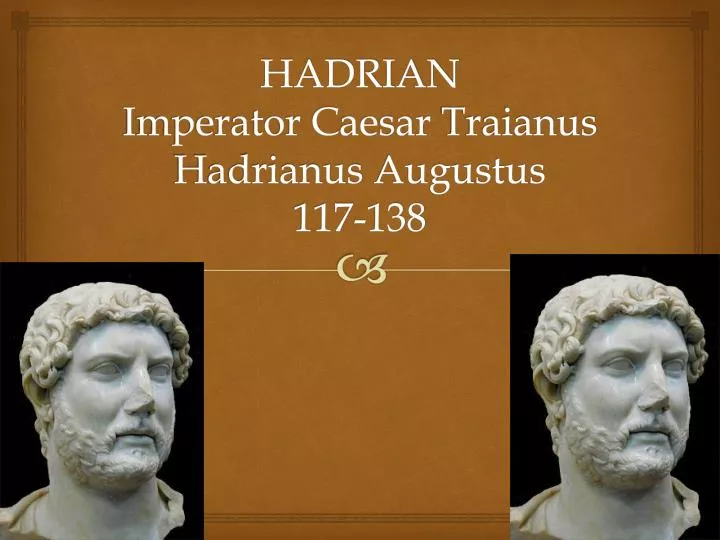
by
Damien F. Mackey
When reading through Anthony Everitt’s 392-page book, Hadrian and the Triumph of Rome (Random House, NY, 2009), I was struck by the constant flow of similarities between Hadrian and Augustus - which the author himself does nothing to hide.
Here are some of them:
Pp. 190-191:
Ten years into his reign, Hadrian announced to the world that, speaking symbolically, he was a reincarnation of Augustus.
P. x:
… Augustus, whom Hadrian greatly admired and emulated.
P. 145:
Flatterers said that [Hadrian’s] eyes were languishing, bright, piercing and full of light”. …. One may suspect that this was exactly what Hadrian liked to hear (just as his revered Augustus prided himself on his clear, bright eyes).
P. 190:
… the true hero among his predecessors was Augustus.
For the image on Hadrian’s signet ring to have been that of the first princeps was an elegantly simple way of acknowledging indebtedness …. Later, he asked the Senate for permission to hang an ornamental shield, preferably of silver, in Augustus’ honor in the Senate.
P. 191:
What was it that Hadrian valued so highly in his predecessor? Not least the conduct of his daily life. Augustus lived with conscious simplicity and so far as he could avoided open displays of his preeminence.
P. 192:
Both Augustus and Hadrian made a point of being civiles principes, polite autocrats.
….
Whenever Augustus was present, he took care to give his entire attention to the gladiatorial displays, animal hunts, and the rest of the bloodthirsty rigmarole. Hadrian followed suit.
P. 193:
Hadrian followed Augustus’ [consulship] example to the letter - that is, once confirmed in place, he abstained.
….
Hadrian’s imitation of Augustus made it clear that he intended to rule in an orderly and law- abiding fashion ... commitment to traditional romanitas, Romanness. It was on these foundations that he would build the achievements of his reign.
Like the first princeps, Hadrian looked back to paradigms of ancient virtue to guide modern governance. Augustus liked to see himself as a new Romulus …. Hadrian followed suit ….
P. 196:
[Juvenal] was granted … a pension and a small but adequate farmstead near Tibur …. Hadrian was, once again, modelling himself on Augustus, who was a generous patron of poets ….
P. 202:
[Hadrian] conceived a plan to visit every province in his wide dominions. Like the first princeps, he liked to see things for himself….
P. 208:
Hadrian introduced [militarily] the highest standards of discipline and kept the soldiers on continual exercises, as if war were imminent. In order to ensure consistency, he followed the example of Augustus (once again) … by publishing a manual of military regulations.
P. 255:
[Eleusis] … at one level [Hadrian] was merely treading in the footsteps of many Roman predecessors, among them Augustus.
P. 271:
… with his tenth anniversary behind him … the emperor judged the time right to accept the title of Pater Patriae, father of his people. Like Augustus, and probably in imitation of him, he had declined the Senate’s offer for a long time ….
P. 277:
[Hadrian] was soon widely known throughout the Hellenic eastern provinces as “Hadrianos Sebastos Olumpius”, Sebastos being the Greek word for Augustus ….
P. 322:
The consecration ceremony was modeled on the obsequies of Augustus.
Part Two:
Here are some more comparisons from the same book:
P. 31:
Augustus’ constitutional arrangements were durable and, with some refinements, were still in place a hundred years later when the young Hadrian was becoming politically aware.
P. 58:
In Augustus’ day, Virgil, the poet laureate of Roman power, had sung of an imperium sine fine. A century later he still pointed the way to an empire without end and without frontiers.
P. 130:
… [Hadrian] depended on friends to advise him. Augustus adopted this model ….
P. 168:
So far as Hadrian was concerned [the Senate] offered him the high title of pater patriae ….
He declined, taking Augustus’ view that this was one honor that had to be earned; he would defer acceptance until he had some real achievements to his credit.
P. 173:
So military and financial reality argued against further enlargement of the empire. … Augustus, who had been an out and out expansionist for most of his career ….
… the aged Augustus produced a list of the empire’s military resources very near the end of his life. …. Hadrian may well have seen a copy of, even read, the historian’s [Tacitus’] masterpiece.
P. 188:
… all the relevant tax documents were assembled and publicly burned, to make it clear that this was a decision that could not be revoked. (Hadrian may have got the idea for the incineration from Augustus, for Suetonius records that … he had “burned the records of old debts to the treasury, which were by far the most frequent source of blackmail”).
P. 198:
His aim was to create a visual connection between himself and the first princeps, between the structures that Augustus and Agrippa had left behind them and his own grand edifices …. Beginning with the burned-out Pantheon. ….
Hadrian had in mind something far more ambitious than Agrippa’s temple. …. With studied modesty he intended to retain the inscribed attribution to Agrippa, and nowhere would Hadrian’s name be mentioned.
Mackey’s comment: Hmmmm ….
P. 233:
It can be no accident that the ruler [Hadrian] revered so much, Augustus, took the same line on Parthia as he did - namely, that talking is better than fighting.
P. 324:
As we have seen, until the very end of his reign, Augustus was an uncompromising and bellicose imperialist. Dio’s prescription [“Even today the methods that he then introduced are the soldiers’ law of campaigning”] fits Hadrian much more closely, and he must surely have had this example in mind when penning these words.
Part Three
“This is the chief thing:
Do not be perturbed, for all things are according to the nature of the
universal; and in a little time you will be nobody and
nowhere, like Hadrian and Augustus”.
Marcus Aurelius, Meditations
The names “Augustus” and “Hadrian” often get linked together.
For instance, for Hadrian - as we read here: “Augustus was an important role model”:
http://www.britishmuseum.org/explore/themes/leaders_and_rulers/hadrian/ruling_an_empire
Rome’s first emperor, Augustus (reigned 27 BC–AD 14), had also suffered severe military setbacks, and took the decision to stop expanding the empire. In Hadrian’s early
reign Augustus was an important role model.
He had a portrait of him on his signet ring and kept a small bronze bust of him among the images of the household gods in his bedroom.
Like Augustus before him, Hadrian began to fix the limits of the territory that Rome could control. He withdrew his army from Mesopotamia, modern-day Iraq, where a serious insurgency had broken out, and abandoned the newly conquered provinces of Armenia and Assyria, as well as other parts of the empire. ….
Hadrian was even “a new Augustus” and an “Augustus redivivus”.
Thus Anthony R. Birley (Hadrian: The Restless Emperor, p. 147):
Hadrian's presence at Tarraco in the 150th year after the first emperor was given the name Augustus (16 January 27 BC) seems to coincide with an important policy development. The imperial coinage at about this time drastically abbreviates Hadrian's titulature. Instead of being styled 'Imp. Caesar Traianus Hadrianus Augustus’, he would soon be presented simply as 'Hadrianus Augustus'. The message thereby conveyed is plain enough: he wished to be seen as a new Augustus. Such a notion had clearly been in his mind for some time. It cannot be mere chance that caused Suetonius to write in his newly published, Life of the Deified Augustus, that the first emperor had been, ‘far removed from the desire to increase the empire of for glory in war’ — an assertion which his own account appears to contradict in a later passage. Tacitus, by contrast, out of touch – and out of sympathy – with Hadrian from the start, but aware of his aspirations to be regarded as an Augustus redivivus, seems subversively to insinuate, in the Annals, that a closer parallel could be found in Tiberius. ….
“In Hadrian: The Restless Emperor, Anthony Birley, according to a review of his book, “brings together the new ... story of a man who saw himself as a second Augustus and Olympian Zeus”.
Architecture
Hadrian is often presented as a finisher, or a restorer, of Augustan buildings. For example: http://www.open.edu/openlearn/ocw/mod/oucontent/view.php?id=20867&printable
The Pantheon is one of the few monuments to survive from the Hadrianic period, despite others in the vicinity having also been restored by him (SHA, Hadrian 19). What is unusual is that rather than replacing the dedicatory inscription with one which named him, Hadrian kept (or more likely recreated) the Agrippan inscription, reminding the populace of the original dedicator. At first this gives the impression that Hadrian was being modest, as he was not promoting himself. Contrast this with the second inscription on the façade, which commemorates the restoration of the Pantheon by Septimius Severus and Caracalla in 202 CE (CIL 6. 896). However, by reminding people of the Pantheon’s Augustan origins Hadrian was subtly associating himself with the first emperor. This helped him legitimise his position as ruler by suggesting that he was part of the natural succession of (deified) emperors. It is worth noting that Domitian had restored the Pantheon following a fire in 80 CE (Dio Cassius 66.24.2), but Hadrian chose to name the original dedicator of the temple, Agrippa, rather than linking himself with an unpopular emperor. In addition, the unique architecture of the Pantheon, with its vast dome, was a more subtle way for Hadrian to leave his signature on the building than an inscription might have been – and it would have been more easily ‘read’ by a largely illiterate population.
Thomas Pownall (Notices and Descriptions of Antiquities of the Provincia Romana of Gaul),
has Hadrian, “in Vienne”, purportedly repairing Augustan architecture (pp. 38-39):
That the several Trophaeal and other public Edifices, dedicated to the honour of the Generals of the State, were repaired by Augustus himself, or by his order, preserving to each the honour of his respective record of glory, we read in Suetonius …. And it is a fact, that the inhabitants of Vienne raised a Triumphal Arc, to grace his progress and entry into their town. The reasons why I think that this may have been afterward repaired by Hadrian are, first, that he did actually repair and restore most of the Monuments, Temples, public Edifices, and public roads, in the Province: and next that I thought, when I viewed this Arc of Orange, I could distinguish the bas-relieves and other ornaments of the central part of this edifice; I mean particularly the bas-relief of the frieze, and of the attic of the center, were of an inferior and more antiquated taste of design and execution than those of the lateral parts; and that the Corinthian columns and their capitals were not of the simple style of architecture found in the Basilica, or Curia, in Vienne, which was undoubtedly erected in the time of Augustus, but exactly like those of the Maison carrée at Nimes, which was repaired by Hadrian.
La Maison Carrée de Nîmes
Edmund Thomas will go a step further, though, and tell that the Maison carrée belonged, rather, to the time of the emperor Hadrian (Monumentality and the Roman Empire: Architecture in the Antonine Age, p. 50):
Also worth mentioning is the so-called 'Temple of Diana' at Nîmes.
Hadrian is often presented as a finisher, or a restorer, of Augustan buildings. For example: http://www.open.edu/openlearn/ocw/mod/oucontent/view.php?id=20867&printable
The Pantheon is one of the few monuments to survive from the Hadrianic period, despite others in the vicinity having also been restored by him (SHA, Hadrian 19). What is unusual is that rather than replacing the dedicatory inscription with one which named him, Hadrian kept (or more likely recreated) the Agrippan inscription, reminding the populace of the original dedicator. At first this gives the impression that Hadrian was being modest, as he was not promoting himself. Contrast this with the second inscription on the façade, which commemorates the restoration of the Pantheon by Septimius Severus and Caracalla in 202 CE (CIL 6. 896). However, by reminding people of the Pantheon’s Augustan origins Hadrian was subtly associating himself with the first emperor. This helped him legitimise his position as ruler by suggesting that he was part of the natural succession of (deified) emperors. It is worth noting that Domitian had restored the Pantheon following a fire in 80 CE (Dio Cassius 66.24.2), but Hadrian chose to name the original dedicator of the temple, Agrippa, rather than linking himself with an unpopular emperor. In addition, the unique architecture of the Pantheon, with its vast dome, was a more subtle way for Hadrian to leave his signature on the building than an inscription might have been – and it would have been more easily ‘read’ by a largely illiterate population.
Thomas Pownall (Notices and Descriptions of Antiquities of the Provincia Romana of Gaul),
has Hadrian, “in Vienne”, purportedly repairing Augustan architecture (pp. 38-39):
That the several Trophaeal and other public Edifices, dedicated to the honour of the Generals of the State, were repaired by Augustus himself, or by his order, preserving to each the honour of his respective record of glory, we read in Suetonius …. And it is a fact, that the inhabitants of Vienne raised a Triumphal Arc, to grace his progress and entry into their town. The reasons why I think that this may have been afterward repaired by Hadrian are, first, that he did actually repair and restore most of the Monuments, Temples, public Edifices, and public roads, in the Province: and next that I thought, when I viewed this Arc of Orange, I could distinguish the bas-relieves and other ornaments of the central part of this edifice; I mean particularly the bas-relief of the frieze, and of the attic of the center, were of an inferior and more antiquated taste of design and execution than those of the lateral parts; and that the Corinthian columns and their capitals were not of the simple style of architecture found in the Basilica, or Curia, in Vienne, which was undoubtedly erected in the time of Augustus, but exactly like those of the Maison carrée at Nimes, which was repaired by Hadrian.
La Maison Carrée de Nîmes
Edmund Thomas will go a step further, though, and tell that the Maison carrée belonged, rather, to the time of the emperor Hadrian (Monumentality and the Roman Empire: Architecture in the Antonine Age, p. 50):
Also worth mentioning is the so-called 'Temple of Diana' at Nîmes.
It
was roofed with a barrel-vault of stone blocks, unusual for western
architecture, and its interior walls, with engaged columns framing triangular and
segmental pediments … resemble those of the 'Temple of Bacchus' at Baalbek ….
It seems to have formed part of the substantial augusteum complex
built around a substantial spring …. The date of the building is much disputed;
but the resemblance to the architecture of Baalbek and the association of
Antoninus Pius with Nemausus [Nîmes], may be indications of the Antonine date
formerly suggested. …. Indeed, the famous ‘Maison Carrée’ in the same city,
usually
regarded as an Augustan monument, has recently been redated to the same period, when the town was at its height, and may even be the ‘basilica of wonderful construction’ founded by Hadrian around 122 [sic] ‘in honour of Plotina the wife of Trajan’ ….
regarded as an Augustan monument, has recently been redated to the same period, when the town was at its height, and may even be the ‘basilica of wonderful construction’ founded by Hadrian around 122 [sic] ‘in honour of Plotina the wife of Trajan’ ….

The
Maison Carrée is the best preserved Roman temple in the world today and is a
stunning building to visit.
Sunday, December 22, 2019
Christmas story still resonates down the ages

The first Christmas Day was the moment when eternity announced its presence in time. The immense and the everlasting pierced the thin veil of time.
The power of eternity was made manifest in the weakness of a newborn infant, the most powerless of any human being. And on that paradox, human history has pivoted.
The circumstances were surely as inauspicious as any could be. Mary and Joseph were a refugee family fleeing the savage persecution of Herod and finding rough, temporary shelter.
Remember Mother Teresa, when she picked up a tiny newborn in Kolkata, in circumstances so daunting that birth at all was a miracle: “See! There’s life in her!”
And yet there was also splendour at the first Christmas, as the three magi, the wise men, came to offer gifts.
Christmas remains the most universal, powerful symbol of both humanity and divinity, not only in the West but in the entire world. I have listened, transfixed with delight, to Christmas carols sung in hotel lobbies in Muslim Kuala Lumpur and in many other places.
Christmas has always had its enemies. The chief project of modernity over the past 200 years has been to try to kill God. Even where this dismal endeavour progresses culturally, the God that cannot be killed at all is the infant at Christmas.
Still, as Dickens suggested in A Christmas Carol, you can tell something about a person, and a culture, by their attitude to Christmas.
Thus, in a kind of Monty Python version of antique political correctness beyond parody, the Diversity Council advises companies not to hold Christmas celebrations. I have the closest family and friendship connections with people of many faiths and I have never heard one object to, or fail to enjoy, Christmas celebrations.
Still, it would be wrong to make too much of the Diversity Council’s well-intentioned silliness.
The objection to Christmas comes not from other religions — most celebrate each others’ festivals happily — but from the grinches of militant secularism, the official and dispiriting religion of our time.
In truth, Christmas is a universal symbol that spreads nothing but goodwill and hope to everyone. At every Christmas table surely every neighbour is welcome. It is also true that Christianity is true. And that it is completely distinctive.
It is a common argument against Christianity that the essential wonder of Christmas — of the everlasting, eternal, all-powerful God becoming a defenceless human baby in deepest obscurity — is similar to other religious traditions that also have some men as gods and some gods as men.
It is a characteristic mistake of atheism to hold that the similarities of different religious traditions show that they are all just artificial artefacts, manufactured by men and women like a table or a car. The reverse is true. The recurrence of motifs throughout humanity is rather a sign that a sense of God, an intuition even of the shape of God, of the commerce between heaven and earth, is hardwired into the deepest elements of human nature.
In any event, no other religious tradition has anything equivalent to Christmas. Ancient Roman emperors were sometimes elevated to the status of gods, but theologically this is not much more than saying that Don Bradman was the god of cricket.
Other religions that have gods become men date them to a mythical time. Thus Hinduism, with its deep spiritual beauty and elevated literature, describes Krishna’s adventures on Earth in a time before time.
Christianity stakes its claims to truth on specific historical events in a well-documented time.
No other religion has its supreme god seemingly defeated on Earth, arrested, tortured, humiliated and killed in the most gruesome fashion.
One of our best-credentialled and most prolific historians of biblical times, John Dickson, who teaches at Oxford and Sydney universities, has written a marvellous new book, Is Jesus History?
You could make no greater contribution to cultural literacy than encouraging everybody, certainly every high school and university student, to read it.
Sydney’s Catholic Archbishop, Anthony Fisher, in an enthralling consideration of our historical circumstance, argued recently that Australia is both partly post-Christian and partly pre-Christian.
The two social conditions are somewhat different, but one thing they have in common is a ignorance about the basic facts of Christianity.
Dickson is a believing Christian but in Is Jesus History? he writes as a historian and expertly, readably, shrewdly, unemotionally draws together the most important scholarship on the historical Jesus.
The former Pope Benedict, in his magisterial, scholarly book, Jesus of Nazareth, explains the importance of historicity: “It is of the very essence of biblical faith to be about real historical events. It does not tell stories symbolising supra-historical truths, but is based on history, history that took place here on this Earth.”
Benedict also explains the severe limits of the historical-critical method in trying to deconstruct the New Testament. Concerning biblical critical studies, which once in their wilder speculations did much to undermine religious faith, Benedict writes: “We have to keep in mind the limits of all our efforts to know the past: We can never go beyond the domain of hypothesis because we simply cannot bring the past into the present. To be sure, some hypotheses enjoy a high degree of certainty, but overall we need to remain conscious of the limit of our certainties.”
Dickson makes a different but allied point. Historical research and understanding can only take you to the threshold of decision about whether you believe that the physical resurrection of Jesus, and all the other miracles, took place. History cannot prove the miracles; history certainly cannot disprove them either.
It is similar to the arguments about the existence of God. Reason alone can take you to belief in God, as it did with some ancient Greek philosophers. But reason alone does not prove God. Nor does reason disprove God. There is nothing unreasonable, or irrational, about believing in God.
Our culture reinforces the wholly fraudulent message that science has somehow taken a stand against God. This is untrue and not the least of popular culture’s misrepresentations of science. As our greatest poet, Les Murray, wrote: “Snobs mind us off religion nowadays, if they can.”
Dickson thinks that history can tell us a great deal about Jesus. The overwhelming weight of all recent real research evidence validates the key narrative points of the gospel and other New Testament stories about Jesus.
Dickson assesses the evidence coolly and fairly.
There are several non-Christian references to Jesus in the ancient world. The earliest New Testament texts are some of the letters of Paul, written perhaps 20 years after Jesus’ death. These letters are written to communities of Jesus’ followers who already believe that Jesus rose from the dead and is the son of God. These beliefs are almost universal among Jesus’ followers.
Dickson establishes that the books of the New Testament are the best authenticated documents of the ancient world, apart from inscriptions in stone.
Most of the New Testament scriptures were written independently of each other and their minor discrepancies tend to validate their authenticity.
He offers the illustration. You probably recall exactly when you met your spouse for the first time. But as you tell the story over and over, sometimes you say you were drinking a beer, at other times a glass of wine.
But the name of your spouse, and the impression they made on you, is vivid and unvarying.
Similarly, every archaeological discovery has tended to confirm the authenticity of the Jewish community that the gospels describe. Similarly, the empty tomb of Jesus after his death is recounted in the gospel of Mark, the gospel of John and Paul’s letter to the Corinthians. These were all written independently of each other.
Then, outside the New Testament, there is strong evidence that leaders of Jerusalem in the decades following Jesus’ death claimed that disciples had stolen the body to create an empty tomb. The point of this evidence is that these authorities believed there was an empty tomb that they had to explain.
Perhaps most piquant, the discoverers of the empty tomb were women. But in the ancient Middle East women were regarded as unreliable witnesses, their testimony much discounted in courts. Therefore, as Dickson writes: “If you were making up a story about the resurrection and you wanted your fellow first century readers to believe it, you would not include women as the initial witnesses, unless it happened, perhaps embarrassingly, to be true.”
Dickson is a historian of the highest calibre and he concludes: “If the central claim of Christianity were not a miraculous resurrection but just some extraordinary natural claim, everyone would believe it — assuming we had the same degree of historical evidence which we possess for the resurrection.”
It is important not to misrepresent Dickson here. He is emphatically not claiming history proves the resurrection or the divinity of Jesus.
What history does establish, almost beyond reasonable doubt, is that Jesus lived at the time the gospels say, that he said at least many of the things attributed to him, that he had a reputation as a miracle worker and that his earliest followers, soon after his death, claimed to have seen him, and that the broad movement of his followers believed he had risen from the dead and was the son of God. Many of them believed this so passionately that they went to their deaths rather than deny their beliefs.
These historical facts do not prove that Christianity is true or that Jesus is the son of God.
But the bigoted atheism of our time, which dismisses the rational belief of 2000 years, and holds that all of this is not only not true but mere myth and superstition invented decades or centuries later, is deeply ignorant. It is a completely unearned vanity of the moment, which self-regardingly treats contemporary derangements as timeless and obvious wisdom. This is why it would be so valuable for people to read Dickson’s book, to get some real sense of the evidence.
Even more valuable would be to read a couple of the books of the New Testament itself.
Kanishka Raffel is the dean of St Andrew’s Anglican Cathedral in Sydney. Born in London to Sri Lankan parents, he came to Australia as a child. As a 21-year-old undergraduate at the University of Sydney, he was asked by a friend to read something about Christianity. He thought he would get a book by CS Lewis or some such. Instead his friend got him to read St John’s gospel. I asked him about that experience: “I was struck by the vitality of Jesus. You see him with his friends, arguing with sceptics, stunning the crowd. You also see him in prayer, in intimate contact with his father. In my particular case, having studied the Buddhist scriptures, you don’t really get a sense of the manhood of Buddha.
“Also, I was surprised by the historical realism of it, it’s rooted in time and place. The things Jesus says are very provocative. I found Jesus utterly compelling.”
Leaving aside religious considerations, here is a question of cultural literacy. Beyond the diminishing ranks of church-based religious instruction, is there a single course in any subject in any Australian school or university in which students would read the gospel of St John? Apart from the majesty of the writing — “In the beginning was the Word, and the Word was with God, and the Word was God” — isn’t it worth knowing something of the story at the heart of our civilisation?
Our enduring hope in all this remains that vulnerable and homeless infant of the first Christmas. For in weakness, his power is manifest.
Greg Sheridan’s book, God is Good for You, is published by Allen & Unwin.
https://www.theaustralian.com.au/inquirer/christmas-story-still-resonates-down-the-ages/news-story/d68fcbb1f72547028476282cb786c588
Sunday, December 1, 2019
Pope at Angelus: Advent helps us find Jesus in the needs of others

Ahead of the Angelus prayer on Sunday, Pope Francis reflects on the meaning of the Advent season, and invites us to pay attention to the needs of those around us who suffer.
By Devin Watkins
At the beginning of the new liturgical year, the Pope took a moment ahead of the traditional Marian prayer to comment on how the Advent season reminds us that Jesus constantly enters our lives.
He said the certainty that Jesus will return at the end of time urges us to look to the future with confidence and hope.
Drawn to the mountain
Turning to the First Reading, the Pope said the prophet Isaiah paints a picture of the mountain of the Lord’s house to which all nations shall be drawn.
After the Incarnation of the Son of God, said Pope Francis, Jesus revealed Himself as the true temple atop that mountain.
“The marvelous vision of Isaiah is a divine promise,” he said, “and impels us to assume an attitude of pilgrimage, of journeying towards Christ, who is the meaning and goal of history.”
Advent, said Pope Francis, “ is the time to welcome Jesus’ coming, as He comes as a messenger of peace to show us the ways of God.”
Staying awake
In the day’s Gospel reading, Jesus urges us to “stay awake” for His coming.The image of staying awake does not mean keeping one’s eyes literally open at all times, said Pope Francis, but means having one’s heart “free and oriented in the right direction” by offering ourselves for the benefit of others in service.
“The sleep from which we must awake is created by indifference, by vanity, and by the inability to establish genuinely human relationships and to take care of our brothers and sisters who find themselves alone, abandoned, or ill.”
Paying attention to those in need
The Pope said our expectant waiting for Jesus requires vigilance in the form of “marveling at God’s action and at His surprises.”Vigilance, he continued, means “paying attention to our neighbor in difficulty and allowing their need to draw us in, without waiting for him or her to ask us for help.”
Finally, Pope Francis asked the Virgin Mary for her guidance along the Advent journey.
“May Mary, the vigilant Virgin and Mother of hope,” he said, help us “to turn our gaze towards the ‘mountain of the Lord’, the image of Jesus Christ, who draws all people to Himself.”
https://www.vaticannews.va/en/pope/news/2019-12/pope-francis-angelus-advent-journey-reflection.html
Monday, November 11, 2019
Book of Jonah’s long tradition of historicity

“Estimates regarding the duration of the virtually universal acceptance of the historical character of the Book of Jonah range from 1800 years to “at least twenty-one centuries”.”
D. Hart-Davies
There is indisputably a long enduring Jewish-Christian tradition according to which the story of Jonah was a genuine historical account. According to D. Hart-Davies, writing in 1925 (Jonah: Prophet and Patriot): “Jewish tradition, in one unbroken line, testifies to a belief in the historical character of the book …”.
And: “… the Christian Church, with remarkable unanimity has confirmed the Jewish tradition …”.
By way of contrast, Hart-Davies would then give the modern opinion:
Such, however, is not the view which is generally held by modern theologians. The allegorical interpretation is widely accepted. Many treat the narrative as a fiction, with or without a very slight framework of history to rest upon. By many the non-historical character of the book is regarded as indisputable. A writer who ventures to maintain the opposite runs the risk of meeting, in certain quarters, with ridicule or invective. Sir George Adam Smith thus declaims: “How long, O Lord, must Thy poetry suffer from those who can only treat it as prose? On whatever side they stand, sceptical or orthodox, they are equally pedants, quenchers of the spiritual, creators of unbelief” ….
But, responded Hart-Davies, a fervent believer in the book’s historicity:
A strong case, surely, does not require to be buttressed by the immoderate terms of such an apostrophe. For it must not be forgotten that the great majority of Hebraists and theologians of the Church Universal, from Jerome and Augustine to Pusey and Perowne, are included in the compass of the distinguished professor’s denunciation.
Estimates regarding the duration of the virtually universal acceptance of the historical character of the Book of Jonah range from 1800 years to “at least twenty-one centuries”, wrote Hart-Davies. The matter really depends upon a determination of its date of authorship, its terminus a quo.
We know the approximate terminus ante quem, when what Hart-Davies called the “unbroken” tradition, was broken.
It is, as I (Damien Mackey) said at the start of this section, an extremely long tradition. The antiquity of the tradition, and the force of ancient Christians’ enthusiasm for the story of Jonah, is borne out in this statement by Hart-Davies:
The Catacombs in Rome bear striking evidence of the belief of the early Christians. No Biblical subject was more popular for mural and sarcophagi representation, in those underground cemeteries of the disciples of Jesus, than that of Jonah’s submergence and deliverance as a symbol of faith and hope in the resurrection.
“The history of Jonas [Jonah] having been put forward so emphatically by our Lord Himself, as a type both of His own and of the general resurrection, it is not to be wondered at that it should have held the first place among all the subjects from the Old Testament represented in the Catacombs. It was continually repeated in every kind of monument connected with the ancient Christian cemeteries; in the frescoes on the walls, on the bas-reliefs of the sarcophagi, on lamps and medals, and glasses, and even on the ordinary gravestones. Christian artists, however, by no means confined themselves to that one scene in the life of the prophet in which he foreshadowed the resurrection, viz., his three days’ burial in the belly of the fish, and his deliverance from it, as it were from the jaws of the grave. The other incident of his life was painted quite as commonly, viz., his lying ‘under the shadow of the booth covered with ivy on the east side of the city’ for refreshment and rest; or again, his misery and discontent, as he lay in the same place, when the sun was beating upon his head and the ivy had withered away”.
…. Jerome … wrote a commentary on it; and the sermons and writings of Irenaeus, Augustine, Chrysostom, and other Fathers, abound in references which show conclusively that their belief in the historicity of Jonah was unquestioned. A long and bitter controversy was waged between Jerome and Augustine as to the nature of the plant which overshadowed the prophet; but, as to the historical character of the narrative itself, they were absolutely agreed. ….
Hart-Davies appended an interesting footnote to this section; one which demonstrates how well instructed in Scripture were at least the early African Christians.
When the bishop who read the lesson changed the word cucurbita (a gourd) into hedera (ivy), “the whole congregation”, he wrote, “protested, and would not allow the lection to proceed till the word to which they were accustomed was adopted”.
Now, imagine what might have been the reaction of these ancient Christians had they heard from the pulpit, as I did have quite recently, that Jonah was a “didactic fiction”, written in “C5th BC post-exilic times”, and that it is only according to an appreciation of such a genre that one might be able to formulate an answer to a schoolchild’s simple question: “Was Jonah really in the belly of the whale?” It is all a matter of genre, we are told.
Subscribe to:
Posts (Atom)